save
$29.01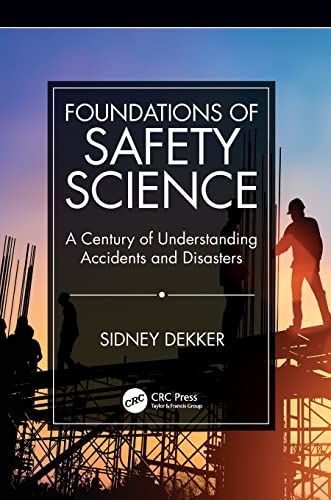
Foundations of Safety Science by Sidney Dekker
Get the Foundations of Safety Science ebook — the definitive overview of the theories shaping modern accident prevention and safety management.
$23.99$53.00
The Challenge It Addresses
Foundations of Safety Science solves the problem of fragmented safety knowledge. After more than a century of studying accidents and disasters, the safety field has accumulated dozens of theories — yet most professionals only ever learn a handful of them. The result is a workforce that knows how to apply individual models but rarely understands why those models exist, where they came from, or how they connect.
This fragmentation has real consequences. Safety practitioners trained in a single theory often struggle to explain contradictory accident evidence, or find themselves unable to adapt when a familiar model fails. Students entering the field inherit isolated frameworks with no sense of the intellectual history behind them.
Foundations of Safety Science closes that gap. It delivers a comprehensive overview of the theoretical foundations of the discipline, showing the interlinkages and cross-connections between them, so you understand the whole landscape — not just isolated pieces of it.
About Foundations of Safety Science by Sidney Dekker (eBook)
Foundations of Safety Science is a comprehensive overview of the theoretical foundations of safety science. Written by Sidney Dekker and published by CRC Press in 2019, it traces how the field has explained accidents and disasters — and how those explanations have evolved, diverged, and reconnected over time.
The subtitle, “A Century of Understanding Accidents and Disasters,” signals the book’s ambition. Rather than championing one preferred model, it presents the entire field: the major theories, the historical conditions that shaped them, and the surprising ways they interlock.
What makes this text distinctive is its insistence on connections. Most safety books present theories as isolated alternatives; this one shows how approaches that are usually treated as competing schools of thought actually share conceptual DNA. Each tradition is presented as part of an intellectual ecosystem, giving you the conceptual scaffolding to evaluate any safety claim you encounter in practice or in the literature.
For readers already familiar with safety science, the book works as a system map: it clarifies how human factors, organizational theory, and systems engineering all contribute to the modern understanding of safety. For newcomers, it provides the coherent introduction that fragmented course readings rarely supply.
Who Should Read This Book?
This book is for anyone who needs to understand why accidents happen and how safety is actually achieved. Its scope makes it valuable across professional, academic, and regulatory contexts.
Occupational health and safety (OHS) professionals will find it especially valuable. The book gives the field a coherent intellectual core, strengthening safety practice as a genuine profession rather than a checklist discipline.
Here is who will get the most from this ebook.
- Safety engineers and HSE managers seeking a broader theoretical foundation for daily decisions
- Accident investigators who want to understand the assumptions built into their investigation models
- University students in safety science, human factors, engineering, and risk management programs
- Graduate researchers looking for a structured map of the safety literature and its debates
- Risk and reliability analysts in high-hazard industries such as aviation, energy, healthcare, and transport
- Consultants and trainers who must explain safety concepts credibly to diverse audiences
- Regulators and policy professionals who shape safety standards and legislation
If your work touches accident causation, risk control, or system reliability, this book belongs in your professional library. It is equally suited to newcomers who need a coherent entry point and to experienced practitioners who want to re-examine their assumptions.
What You Will Learn
Foundations of Safety Science is not a prescriptive how-to manual — it is a deep intellectual grounding that changes how you think about risk, failure, and prevention. Here are the key things you will learn from it.
- The full intellectual history of safety science — how a century of theorists have framed the problem of why things go wrong, from classic accident models to resilience engineering.
- Why different theories produce different interventions — and why two experts can analyze the same incident and prescribe opposite fixes.
- The interlinkages and cross-connections between theories — how apparently rival schools of thought build on shared foundations.
- The shift from blaming individual error to understanding systemic failure — and why that shift transforms what prevention looks like.
- How to evaluate safety claims critically — the conceptual tools to test whether a proposed intervention aligns with sound theory.
- The working vocabulary of modern safety discourse — enough command of the field’s concepts to engage with academic literature and professional debate confidently.
- Why no single model explains every accident — and how to combine complementary perspectives for more robust analysis.
- How safety science continues to evolve — from linear cause-and-effect models toward complexity, emergence, and resilience-based approaches.
These outcomes reinforce one another. The book is structured so that theoretical insight translates directly into professional judgment — whether you are investigating an incident, designing a safety management system, or advising leadership on risk.
What Sets It Apart
Foundations of Safety Science outperforms every alternative because it spans the entire field. Most safety books on the market fall into one of two camps: the single-model text, which argues passionately for one framework — human factors, high-reliability organizing, or resilience engineering — and treats everything else as background noise.
The second camp is the compliance handbook, which prescribes what to do without explaining why the approach is theoretically grounded. This book gives you the entire field instead of a single lens. It hands you the complete set of lenses — and shows you how they fit together — making it a more durable investment for your career, your organization, and your understanding of safety.
Here is how it outperforms the typical alternatives you will come across.
- Breadth: covers the complete theoretical landscape rather than a single favored school of thought
- Depth: treats each framework seriously instead of caricaturing it before discarding it
- Context: grounds every theory in the historical conditions that produced it
- Integration: emphasizes the interlinkages that single-theory books cannot see
- Longevity: remains a reference you will return to long after a certification course is over
For OHS professionals, this comprehensiveness carries real weight. A discipline that cannot articulate its own intellectual foundations cannot claim professional status. Foundations of Safety Science supplies exactly that foundation, elevating safety practice beyond procedures, checklists, and compliance-driven habits.
Author & Publisher Credentials
This book’s scope is itself the strongest evidence of its authority. A comprehensive overview that traces a full century of theoretical development and maps the connections between schools of thought can only come from an author with a deep command of the safety literature. Sidney Dekker, the author, has devoted his working life to understanding how accidents happen and how safety is created, and this volume is a synthesis of that body of knowledge.
CRC Press, the publisher behind this 2019 edition, is a long-established academic publisher recognized for its science, engineering, and professional reference works. That combination — a credible publisher, an author of acknowledged standing in the field, and a contemporary publication date — gives you confidence in the quality and currency of the content.
When you are building the theoretical foundations of your own professional practice, the credibility of your sources matters. This book comes from a lineage you can trust.
Our Verdict
Yes — for anyone serious about safety as a discipline, the Foundations of Safety Science ebook is worth it. This is not a quick read, and it is not a step-by-step toolkit. It is an intellectual investment that compounds: the more safety problems you confront, the more valuable this theoretical map becomes.
The verdict depends on context. If you need a lightweight checklist or a single framework you can apply tomorrow, a narrower manual might serve you better in the short term. But if you want to understand why safety interventions succeed or fail — and to make sound decisions across the full range of hazards you will face — this book provides the foundation that lighter texts cannot.
This edition delivers lasting professional value at a fraction of the cost of formal education. The ebook format keeps the full text accessible and searchable wherever you work, turning it into a practical reference for daily use rather than a shelf ornament.
The real cost of skipping this book is not the price of the ebook — it is the price of making safety decisions from an incomplete mental model. Every course, every investigation, and every safety program you design will be shaped by the theoretical foundation you build now.
Start Reading Foundations of Safety Science by Sidney Dekker (eBook) Today
Every safety decision you make rests on a theory — whether you are aware of it or not. Foundations of Safety Science makes those theories explicit, connected, and usable. That understanding is the difference between applying a model mechanically and choosing the right approach for the situation in front of you.
Whether you are a safety professional strengthening your practice, a student building a career foundation, or a researcher mapping the field, this book delivers the comprehensive theoretical grounding you need. The 2019 CRC Press edition is available right now as an instant digital download — no shipping, no waiting.
Get your copy of Foundations of Safety Science today to see the entire safety landscape — the theories, their histories, and their interlinkages — with a clarity you will use for the rest of your career. Add to cart now and secure this complete ebook edition while it is readily available.
Related products

TinyML: Machine Learning with TensorFlow Lite on Arduino and Ultra-Low-Power Microcontrollers
$14.99Master TinyML with TensorFlow Lite on Arduino — deploy machine learning models on ultra-low-power microcontrollers with this hands-on guide.
$27.00-
Data-Driven Fluid Mechanics: Combining First Principles and Machine Learning
$21.99Combining first principles and machine learning, this data-driven fluid mechanics book is your essential guide for modern CFD research and practice.
$38.00 -
Advances of Chitin and Chitosan-Based Materials: Preparation and Applications
$13.99Get the latest MDPI reprint on chitin and chitosan materials – essential for researchers in biopolymer science and materials engineering.
$25.00 -
Deep Learning and the Game of Go: Build a Go-Playing AI
$26.99Master deep learning by building a Go-playing AI with this hands-on guide. Get the eBook now and start coding your own bot!
$52.00 -
Hacking: The Art of Exploitation, 2nd Edition – Jon Erickson
$20.99Master buffer overflows, shellcode, and network exploits with this classic hands-on guide. Your complete exploit development foundation starts here.
$40.00 -
Fluid Dynamics of Particles, Drops, and Bubbles by Eric Loth
$14.99Master multiphase flow with Eric Loth’s 2023 Cambridge textbook covering theory, simulations, and experiments for particles, drops, and bubbles.
$26.00 -
Deep Learning for Coders with fastai and PyTorch – Practical AI Guide
$14.99Master practical deep learning with fastai & PyTorch. No heavy math required. Get the authoritative guide by Jeremy Howard & Sylvain Gugger now.
$25.00 -
Facilities Planning and Design – Pearson New International Edition
$10.99Master facility layout and material handling with this Pearson New International Edition. Get the complete analytical toolkit from Garcia-Diaz and Smith — order your ebook now.
$20.00