save
$15.00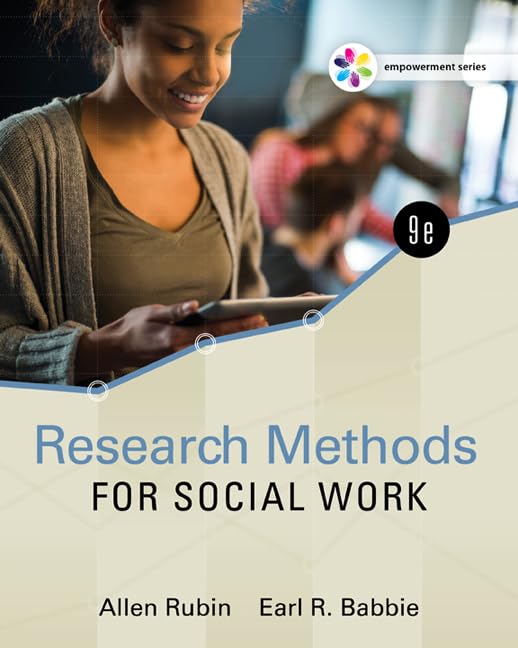
Research Methods for Social Work 9th Edition Rubin & Babbie
Research Methods for Social Work 9e by Rubin & Babbie gives you the evidence-based research mastery your course demands.
Want to preview before you buy? Click Request Free Sample and tell us which chapter or pages you’d like to see, along with your email address. We’ll send you those pages from the eBook so you can be sure it’s the right one before buying.
- Instant download & lifetime access Available as soon as your payment is confirmed. Your download link is also sent to the email address you provide at checkout, and you can download your purchased eBook anytime from My Account → Downloads with unlimited downloads. An account is created automatically using the same email address.
- Own your eBook Receive the available PDF/EPUB file directly after purchase. No rental or temporary access — download and keep your eBook for personal use with lifetime access.
- Full refund guarantee If the eBook you receive does not match the details and description provided on the product page, contact [email protected] and we’ll issue a full refund within 24 hours.
- Secure payment through PayPal Pay securely by debit or credit card or with your PayPal account. Your card details are processed by PayPal and are never stored on our site.
$19.00$34.00
The Problem Research Methods for Social Work Solves
Research methods is the course social work students fear most — not because the material is genuinely beyond them, but because most textbooks present methodology as abstract theory with no visible connection to helping real people. Research Methods for Social Work was written to eliminate that disconnect.
Every practitioner eventually faces questions that direct practice experience cannot answer: whether an intervention truly works, whether an assessment tool is valid for the client population, whether outcomes are being measured accurately. This text trains students to answer those questions with evidence, not guesswork.
For instructors, the challenge is equally steep: teaching rigorous design, sampling, and statistics to students who entered the field for human connection rather than hypothesis testing. The Rubin and Babbie approach meets that challenge by framing research as a practice skill — the professional ability to know whether help is actually helping.
Weak research training has real consequences. Practitioners without it cannot critically read the journals their profession relies on, cannot defend interventions to funders, and cannot contribute to the knowledge base of social work. This book was built to prevent exactly those outcomes.
What Is Research Methods for Social Work 9th Edition Rubin & Babbie? A Complete Overview
Research Methods for Social Work is a comprehensive, practice-focused textbook that teaches students how to conduct, interpret, and apply research in real-world agency and community settings. Published by Cengage Learning in 2017 as the Ninth Edition, it is a cornerstone of the publisher’s Empowerment Series.
The book is co-authored by Allen Rubin and Earl R. Babbie, two of the most established names in research methodology education. Its evolution through eight prior editions reflects sustained adoption across social work programs and continuous refinement based on classroom experience.
The text’s defining feature is balance: quantitative and qualitative research techniques receive integrated, equal treatment. Readers move through the full research process — formulating questions, designing studies, sampling, measuring, analyzing data, and evaluating programs — with consistent attention to ethics and the protection of vulnerable populations.
In short, this is a complete research curriculum in a single volume, structured for a semester-long course but designed to remain useful long after the final exam.
Who Should Read This Book?
This text is calibrated for the full spectrum of social work education and professional development. It serves different readers in different ways, but the following groups will benefit most.
- BSW students completing their required foundation research course
- MSW students designing thesis projects, capstones, or program evaluations
- Doctoral students wanting a rigorous and readable refresher in research design
- Practicing social workers strengthening evidence-based decision-making skills
- Instructors and course designers building a methods syllabus with strong quantitative and qualitative coverage
- Allied human services professionals — counseling, public health, and nonprofit leadership — seeking a social work research foundation
If you are preparing for professional licensure exams, clinical supervision, or agency leadership, Research Methods for Social Work gives you the methodological vocabulary to read research literature critically and defend practice decisions with evidence.
Graduate students in related fields — public health, counseling, and criminology — will also find this applied approach far more accessible than generic social science methodology books.
What You Will Learn
Working through the Ninth Edition builds a complete research toolkit — not just a set of definitions to memorize for an exam. These are the core competencies the book develops.
- Problem formulation — converting a practice concern into a clear, researchable question
- Research design — selecting experimental, quasi-experimental, and nonexperimental strategies that fit real-world constraints
- Qualitative methods — interviewing, observation, and inductive approaches suited to lived experience
- Quantitative methods — measurement, operationalization, and valid instrument development
- Sampling strategies — probability and nonprobability techniques and their trade-offs
- Data analysis — interpreting statistical results and qualitative themes with equal confidence
- Program evaluation — needs assessments, outcome evaluations, and efficiency analyses
- Research ethics — protecting vulnerable populations and navigating institutional review board requirements
- Evidence-based practice — locating, appraising, and applying the best available research
Each competency is presented through the lens of social work practice. Every technique is tied to a realistic agency scenario — a community needs assessment, a clinical outcome study, a program evaluation for a funder — rather than a sterile laboratory exercise.
This practice-centered framing is what separates the book from generic research texts, and it is why the material sticks long after the course ends.
Why Choose This Edition
Competing research methods texts typically fail in one of two directions: they bury readers in abstract methodological theory, or they oversimplify research to the point of practical uselessness. Research Methods for Social Work deliberately avoids both traps.
The co-author pairing is itself a structural advantage. Earl R. Babbie is renowned across the social sciences for “The Practice of Social Research,” one of the most established general methodology texts in higher education. Allen Rubin adds specialized expertise in social work research and evidence-based practice, producing a text that speaks both the language of methodology and the language of direct practice — a duality single-authored alternatives simply cannot replicate.
Where other books treat quantitative and qualitative research as competing camps, this one presents them as complementary instruments in a single professional repertoire. Where generic texts default to abstract academic examples, this one grounds every concept in social work settings: child welfare agencies, mental health clinics, community organizations, schools, and hospital social work departments.
Nor is the book merely theoretical about evaluation. Program evaluation, needs assessment, and single-subject designs receive serious treatment — content that many alternative texts relegate to a single chapter or omit altogether.
Add the track record: a Ninth Edition means this content has been tested, criticized, and refined across many classroom cycles. That iterative maturity is something no first- or second-edition competitor can honestly claim.
Behind the Book
Allen Rubin is a leading figure in social work research education, widely recognized for advancing evidence-based practice within the profession. His scholarship has shaped how social work programs teach intervention research, program evaluation, and clinical effectiveness.
Earl R. Babbie’s influence extends across sociology and the social sciences at large. As the author of foundational methodology texts used in universities worldwide, his name carries authority in virtually every field that teaches empirical inquiry — which makes him a uniquely credible guide for social work students learning design and analysis.
Cengage Learning, one of the largest and most established educational publishers in the world, publishes the book as part of its Empowerment Series dedicated to social work and human services education. The backing of a major academic publisher also means rigorous editorial review, professional indexing, and instructor support materials.
The credential that matters most, however, is continuity. A research methods text that sustains a Ninth Edition has earned the trust of instructors and programs over many years of classroom use. That institutional trust is the strongest quality signal a textbook can offer.
The Bottom Line
Yes — for social work students, instructors, and practitioners alike, this is one of the most dependable research methods investments available. Our verdict is clear: Research Methods for Social Work delivers exceptional value.
The Ninth Edition’s balanced treatment of quantitative and qualitative research techniques makes it unusually complete. Few textbooks integrate program evaluation, research ethics, and evidence-based practice into a single coherent curriculum the way Rubin and Babbie do.
For instructors, the proven structure and established organization reduce course preparation burden while ensuring consistent coverage of core research competencies.
For practitioners, the book functions as a systematic refresher on evaluating interventions and staying accountable to evidence-based standards.
Compared with the cost of a single course — or the professional cost of making intervention decisions without evidence — the price of this book is modest. It is an investment in professional competence that keeps paying long after the semester ends.
Add Research Methods for Social Work 9th Edition Rubin & Babbie to Your Library
Your research methods course is not a hurdle to clear — it is the foundation of every evidence-based decision you will make as a professional. Whether you are a BSW or MSW student preparing for the coming semester, an instructor selecting a proven classroom text, or a practitioner upgrading your evaluation skills, this Ninth Edition is the right tool for the job.
The Ninth Edition remains a current, widely used standard in social work education, and this digital edition is available for immediate access. Add Research Methods for Social Work to your cart today and build the research skills that define competent, accountable practice.
Related products

Groups: Process and Practice 10th Edition – Group Counseling Text
$30.00Master group counseling with Corey & Corey’s 10th Edition – the definitive guide blending theory, ethics, and practical skills for students and professionals.
$79.00-
ACA Ethical Standards Casebook, 7th Edition – Barbara Herlihy & Gerald Corey
$29.00Master the 2014 ACA Code of Ethics with real-world case studies from leading experts Herlihy & Corey. The essential guide for ethical counseling practice.
$64.00 -
Behavioral Genetics 7th Edition – Knopik, Neiderhiser, deFries, Plomin
$20.00Master heredity, DNA, and genetic methods with Behavioral Genetics, 7th Edition—the authoritative textbook by Knopik, Neiderhiser, deFries, and Plomin from Worth Publishers.
$41.00 -
Culture Sketches: Case Studies in Anthropology 6th Edition
$29.00Get the 6th edition of Culture Sketches: 15 ethnographic case studies that bring cultural anthropology to life—ideal for any introductory course.
$75.00 -
Theories of Development: Concepts and Applications (6th Edition)
$22.00Get the 6th edition of Crain’s classic text covering 24 developmental theorists. Ideal for psychology students. Order your digital copy today!
$49.00 -
A History of Psychology 2nd Edition – Global & Inclusive
$54.99This 2nd edition covers the history of psychology, including philosophical origins, women, minorities, and a new clinical chapter. Order now!
$184.00 -
Applied Sport Psychology 7e: Personal Growth to Peak
$29.99Achieve peak performance with Applied Sport Psychology 7e. Master proven psychological techniques for personal growth. Get your digital copy today.
$59.00 -
Ethical, Legal, and Professional Issues in Counseling, 6th Ed
$49.99Master ethical practice with the 6th edition of Ethical, Legal, and Professional Issues in Counseling. Essential for students and professionals. Order today.
$119.00