save
$36.01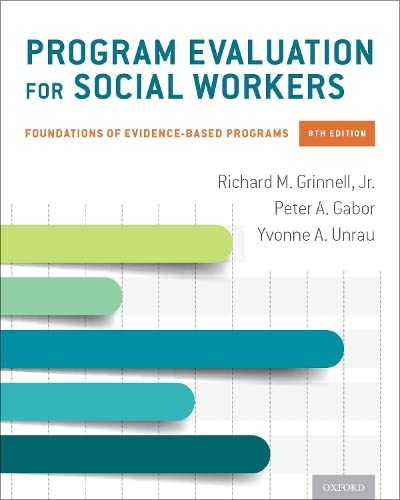
Program Evaluation for Social Workers: Foundations of Evidence-Based Programs 8th Edition
Master program evaluation with the trusted 8th edition of Program Evaluation for Social Workers. Get a practical, step-by-step guide to evidence-based practice. Order now and build skills that prove program impact.
Want to preview before you buy? Click Request Free Sample and tell us which chapter or pages you’d like to see, along with your email address. We’ll send you those pages from the eBook so you can be sure it’s the right one before buying.
- Instant download & lifetime access Available as soon as your payment is confirmed. Your download link is also sent to the email address you provide at checkout, and you can download your purchased eBook anytime from My Account → Downloads with unlimited downloads. An account is created automatically using the same email address.
- Own your eBook Receive the available PDF/EPUB file directly after purchase. No rental or temporary access — download and keep your eBook for personal use with lifetime access.
- Full refund guarantee If the eBook you receive does not match the details and description provided on the product page, contact [email protected] and we’ll issue a full refund within 24 hours.
- Secure payment through PayPal Pay securely by debit or credit card or with your PayPal account. Your card details are processed by PayPal and are never stored on our site.
$21.99$58.00
The Gap This Book Fills
Social workers and human service professionals are under increasing pressure to demonstrate that their programs achieve measurable outcomes. Funders demand evidence, policymakers require accountability, and clients deserve services that actually work. Yet many practitioners lack the research and evaluation skills needed to design, implement, and interpret program evaluations effectively. Program Evaluation for Social Workers: Foundations of Evidence-Based Programs, now in its eighth edition (2019), directly addresses this gap by providing a clear, step-by-step framework for conducting evaluations that meet professional standards and funding requirements.
Program Evaluation for Social Workers: Foundations of Evidence-Based Programs 8th Edition at a Glance
Program Evaluation for Social Workers is the leading textbook for teaching evidence-based program evaluation in social work education. Authored by Richard M. Grinnell, Jr., Peter A. Gabor, and Yvonne A. Unrau, this comprehensive text bridges the gap between research methods and real-world practice. It offers a practical, time-tested approach that equips both graduate and undergraduate students, as well as practicing professionals, with the tools to evaluate programs at the case and program levels.
The eighth edition reflects the latest developments in the field, including expanded coverage of qualitative methods, cultural competence in evaluation, and the use of technology for data collection and analysis. With its accessible writing style and extensive case examples, the book demystifies complex concepts and makes evaluation skills attainable for all social workers.
Who Should Read This Book?
This book is essential for anyone who needs to design, implement, or use program evaluations to improve social services. Specifically, it is ideal for:
- MSW and BSW students enrolled in research or evaluation courses
- Practicing social workers who need to demonstrate program effectiveness to funders and stakeholders
- Program directors and managers seeking to build evaluation capacity within their organizations
- Human service professionals transitioning into roles that require evidence-based decision-making
- Doctoral candidates preparing for research-focused careers in social work
- Policy advocates who need data to support their recommendations
If you are a student or professional who wants to move beyond relying on intuition or anecdote to prove your program’s value, this book is your roadmap.
Inside: What You Will Master
By working through this text, you will gain mastery over the essential competencies of program evaluation. Here are the seven critical skills you will develop:
- How to define program goals and objectives in measurable, observable terms that align with stakeholder expectations
- How to select and design appropriate evaluation designs, including experimental, quasi-experimental, and single-subject designs for case-level evaluations
- How to choose and construct valid measurement instruments that capture the outcomes that matter most to your clients and funders
- How to collect and manage data ethically, including strategies for engaging diverse populations and ensuring informed consent
- How to analyze quantitative and qualitative data using practical techniques that do not require advanced statistical expertise
- How to interpret evaluation findings and communicate them clearly to non-technical audiences, such as board members and community stakeholders
- How to use evaluation results to improve programs continuously and build a culture of evidence-based practice within your organization
How It Compares
While other evaluation textbooks may cover the same topics, none match the unique combination of accessibility, comprehensiveness, and practice orientation found in Grinnell, Gabor, and Unrau’s text. Here is what sets the eighth edition apart:
- Case-level evaluation focus: Unlike most texts that emphasize only program-level evaluation, this book provides extensive coverage of single-subject designs—a critical skill for clinical social workers tracking individual client progress
- Cultural competence integration: The eighth edition embeds cultural considerations throughout every chapter, not as a standalone add-on, ensuring evaluations are respectful and relevant for diverse communities
- Technology tools: Includes guidance on using Excel, SPSS, and web-based survey tools for data collection and analysis, reflecting the digital reality of modern practice
- Ethical decision-making framework: The book dedicates an entire chapter to ethics, covering issues like confidentiality when sharing data, informed consent in vulnerable populations, and navigating conflicts of interest
- Real-world case examples: Each chapter opens with a case vignette drawn from actual social work settings, making abstract concepts concrete and memorable
About the Author
The credibility of any textbook rests on the expertise of its authors and the reputation of its publisher. Richard M. Grinnell, Jr. is a professor emeritus and internationally recognized scholar in social work research and evaluation. Peter A. Gabor brings decades of experience in program evaluation across multiple human service systems. Yvonne A. Unrau is a professor and researcher whose work focuses on child welfare and evaluation methodology. Together, they represent a combined century of teaching and practice in social work evaluation.
Oxford University Press, one of the world’s most prestigious academic publishers, stands behind this work. OUP’s rigorous peer-review process ensures that the content is both academically sound and practically relevant. This eighth edition, published in 2019, has been updated to reflect current standards from the Council on Social Work Education (CSWE) and the latest research on evidence-based practice.
Is It Worth It?
For any social work student or professional seeking to master program evaluation, the answer is unequivocally yes. The eighth edition of Program Evaluation for Social Workers is not just a textbook—it is a practical toolkit that will serve you throughout your career. The book’s step-by-step approach reduces anxiety about research methods, while its emphasis on real-world application ensures that what you learn is immediately useful.
Compared to alternatives like Utilization-Focused Evaluation or Evaluation: A Systematic Approach, this text is more accessible for social workers specifically, with examples drawn directly from social service settings. Its coverage of single-subject designs—a skill few other textbooks address—makes it indispensable for clinical practitioners.
Our verdict: If you need to demonstrate the effectiveness of your programs, pass your evaluation course, or build a culture of evidence in your agency, this book is the most efficient investment you can make.
Get Your Copy Today
Your ability to secure funding, prove your program’s impact, and improve client outcomes depends on your evaluation skills. The eighth edition (2019) of Program Evaluation for Social Workers gives you a proven, time-tested framework to do exactly that. Whether you are a student preparing for your research course or a seasoned professional looking to strengthen your agency’s accountability, this text will equip you with the knowledge and confidence you need.
Order your digital copy today and start building the evaluation skills that will set you apart in the social work field. Your clients—and your funders—deserve nothing less.
Related products

Clinical Assessment Workbook: Balancing Strengths and Differential Diagnosis 2nd Edition
$30.99Master clinical assessment with a strengths-based, DSM-5-aligned workbook. Hands-on cases and worksheets build differential diagnosis skills.
$75.00-
Constitutional Law for a Changing America: Rights, Liberties, and Justice 10th Edition
$14.99Understand how political forces shape Supreme Court rulings on rights, liberties, and justice with this acclaimed 10th edition textbook by Epstein and Walker.
$29.00 -
Culture Sketches: Case Studies in Anthropology 6th Edition
$29.00Get the 6th edition of Culture Sketches: 15 ethnographic case studies that bring cultural anthropology to life—ideal for any introductory course.
$75.00 -
The Certification of Insanity: Local Origins and Imperial Consequences
$39.99The first systematic study of lunacy certification in the British Empire, examining local origins and imperial consequences through legal and archival sources.
$132.00 -
Designing and Conducting Mixed Methods Research 3rd Edition
$26.00Get the definitive guide to designing and conducting mixed methods research: the Third Edition by Creswell and Plano Clark covers seven designs and practical integration.
$71.00 -
Becoming a Helper 8th Edition – Marianne & Gerald Corey eBook
$28.99Start your helping career with Corey & Corey’s Becoming a Helper, 8th Edition eBook—self-reflection, ethics, diversity, and practical skills in one essential guide.
$96.00 -
Methods in Behavioral Research 14th Edition – Cozby & Bates
$28.00Master behavioral research methods with Cozby & Bates’ 14th edition. SmartBook support, clear examples, and proven pedagogy. Get your digital copy today!
$51.00 -
Ethical Dilemmas and Decisions in Criminal Justice, 10th Edition
$30.00Master ethical decision-making in criminal justice with this comprehensive guide to real-world dilemmas in policing, courts, and corrections.
$78.00