save
$92.01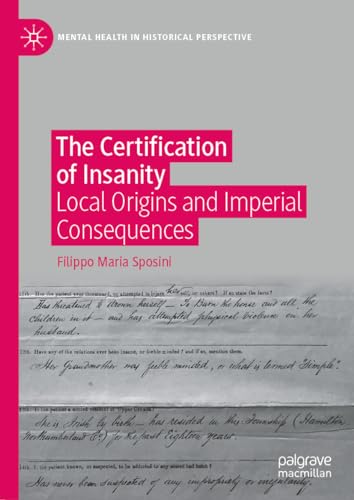
The Certification of Insanity: Local Origins and Imperial Consequences
The first systematic study of lunacy certification in the British Empire, examining local origins and imperial consequences through legal and archival sources.
Want to preview before you buy? Click Request Free Sample and tell us which chapter or pages you’d like to see, along with your email address. We’ll send you those pages from the eBook so you can be sure it’s the right one before buying.
- Instant download & lifetime access Available as soon as your payment is confirmed. Your download link is also sent to the email address you provide at checkout, and you can download your purchased eBook anytime from My Account → Downloads with unlimited downloads. An account is created automatically using the same email address.
- Own your eBook Receive the available PDF/EPUB file directly after purchase. No rental or temporary access — download and keep your eBook for personal use with lifetime access.
- Full refund guarantee If the eBook you receive does not match the details and description provided on the product page, contact [email protected] and we’ll issue a full refund within 24 hours.
- Secure payment through PayPal Pay securely by debit or credit card or with your PayPal account. Your card details are processed by PayPal and are never stored on our site.
$39.99$132.00
The Challenge It Addresses
For historians, legal scholars, and mental health professionals, the nineteenth-century British Empire presents a paradox: while it exported ideas of legal reform and medical progress, its colonies also produced vast, often arbitrary systems for certifying individuals as insane. The lack of a comprehensive, transnational study of this certification process has left a critical gap in our understanding of how imperial governance, local legal cultures, and emerging psychiatric authority intersected. The Certification of Insanity: Local Origins and Imperial Consequences directly addresses this gap, offering the first systematic examination of lunacy certification across the British Empire.
This book is essential for anyone seeking to understand the historical roots of modern mental health law, the colonial administration of madness, and the enduring legacies of imperial psychiatry. Without this work, scholars and practitioners rely on fragmented regional studies that fail to capture the empire-wide patterns and local variations that defined the certification of insanity.
Inside The Certification of Insanity: Local Origins and Imperial Consequences: A Full Overview
The Certification of Insanity: Local Origins and Imperial Consequences is a 2023 monograph by historian Filippo Maria Sposini, published by Palgrave Macmillan as part of the Mental Health in Historical Perspective series. The book provides the first systematic study of the certification of lunacy in the British Empire during the second half of the nineteenth century. It examines a variety of legal, archival, and published sources from multiple colonies, including India, Canada, Australia, and the Caribbean, to reveal how local practices shaped imperial policy and vice versa.
The work is organized around three core themes: the local origins of certification procedures, the imperial networks that transmitted and transformed these procedures, and the consequences of certification for individuals, families, and colonial states. Sposini argues that the certification of insanity was not a uniform medical or legal process but a highly localized practice that reflected the political, social, and racial dynamics of each colony. This book is a foundational text for scholars of colonial psychiatry, legal history, and the history of medicine.
Who Should Read This Book?
The Certification of Insanity is a specialized academic work aimed at several distinct audiences. It is ideal for graduate students and researchers in history, particularly those focusing on the British Empire, colonial medicine, or the history of psychiatry. Legal historians and scholars of mental health law will find the book’s detailed analysis of certification statutes and procedures invaluable. Psychiatrists, psychologists, and mental health professionals interested in the historical antecedents of contemporary commitment laws will gain critical context from this study. Finally, librarians and archivists building collections in colonial studies, medical humanities, or imperial history will consider this a necessary addition.
This book is not a general-interest history or a clinical guide. It is a rigorous, research-driven monograph that assumes familiarity with historical methods and the broader historiography of empire and psychiatry. Readers seeking a narrative history of madness in the colonies should look elsewhere; this work is a scholarly analysis of legal and administrative processes.
Key Takeaways
Readers of The Certification of Insanity will gain deep, evidence-based insights into the following critical areas:
- The local origins of certification: How specific colonial contexts—from British India to the Canadian provinces—developed unique legal and medical procedures for certifying insanity, often drawing on local customs and administrative needs.
- Imperial networks of knowledge: How certification practices, forms, and legal frameworks circulated across the empire through colonial officials, medical journals, and legislative models, creating a patchwork of shared but adapted procedures.
- The role of race and class: How certification was applied differently to European settlers, indigenous populations, and enslaved or indentured laborers, revealing deep biases in the diagnosis and institutionalization of madness.
- The consequences for individuals: Detailed case studies of how certification affected the lives of those deemed insane, including their families, property rights, and personal freedom, drawn from archival records.
- The relationship between certification and asylum expansion: How the increasing use of legal certification drove the construction of large colonial asylums and shaped the geography of mental health care in the empire.
- The legacy for modern mental health law: How the imperial certification systems influenced twentieth-century legislation in former colonies and continue to echo in debates about involuntary commitment and human rights.
Why This Book Stands Out
While several excellent studies exist on colonial psychiatry—such as Waltraud Ernst’s Mad Tales from the Raj or James Mills’s Madness, Cannabis and Colonialism—none provide the empire-wide, comparative focus of Sposini’s work. The Certification of Insanity is the first book to systematically examine the certification process itself, rather than focusing solely on asylums or medical theories. This procedural focus is its key differentiator.
Where other works are limited to a single colony or region, Sposini draws on sources from India, Canada, Australia, the Caribbean, and Africa, allowing for genuine comparative analysis. The book also benefits from its publication in 2023, incorporating the latest historiographical debates and archival discoveries that older studies cannot. For scholars seeking a comprehensive, up-to-date, and methodologically innovative treatment of the subject, this book has no direct competitor.
About the Author
Filippo Maria Sposini is a historian of psychiatry and the British Empire, whose research has been published in leading journals in the field. His expertise in legal and medical archives across multiple continents is evident in the depth of the primary source material used in this book. Palgrave Macmillan, the publisher, is a globally respected academic imprint specializing in the humanities and social sciences. The book appears in the Mental Health in Historical Perspective series, a curated collection known for its rigorous peer-review and high scholarly standards. This combination of author expertise and publisher reputation ensures that the book meets the highest standards of academic trustworthiness.
Is It Worth It?
For its target audience of historians, legal scholars, and advanced students, The Certification of Insanity is not just worth it—it is indispensable. The book fills a clear gap in the literature, offers original research, and is published by a top-tier academic press. At its price point, it represents a sound investment for university libraries, research institutes, and individual scholars whose work touches on colonial psychiatry, legal history, or the history of medicine.
The book’s strength lies in its systematic, comparative approach and its meticulous use of archival evidence. The only potential drawback is its narrow focus on certification procedures, which may be too specialized for readers seeking a broader social or cultural history of madness. However, for those specifically interested in the legal and administrative mechanisms of empire, this is the definitive study.
Get Your Copy Today
If you are a historian, legal scholar, or graduate student researching colonial psychiatry, imperial governance, or the history of mental health law, The Certification of Insanity is a critical resource that will shape your understanding of the field. This 2023 edition from Palgrave Macmillan represents the most current and comprehensive treatment of the subject available. Add it to your cart today and gain access to the first systematic study of lunacy certification in the British Empire—a work that will inform your research for years to come.
Related products

Generalist Social Work Practice: An Empowering Approach (8th Edition) – Pearson
$27.99Master empowerment-focused social work with this widely adopted 8th edition. Build client strengths, navigate multi-level systems, and pass your licensure exam with confidence.
$75.00-
A History of Modern Psychology, 5th Edition – C. James Goodwin
$5.00Goodwin’s 5th edition offers a comprehensive, engaging history of modern psychology. Perfect for students and professionals—get your digital copy now!
$15.00 -
Clinical Assessment Workbook: Balancing Strengths and Differential Diagnosis 2nd Edition
$30.99Master clinical assessment with a strengths-based, DSM-5-aligned workbook. Hands-on cases and worksheets build differential diagnosis skills.
$75.00 -
Exploring Child Welfare: A Practice Perspective, 7th Ed.
$28.00Get the 7th edition of Exploring Child Welfare: A Practice Perspective, a trauma-informed textbook for social work students and professionals. Order your Pearson eTextbook today.
$89.00 -
Applied Sport Psychology 7e: Personal Growth to Peak
$29.99Achieve peak performance with Applied Sport Psychology 7e. Master proven psychological techniques for personal growth. Get your digital copy today.
$59.00 -
Data Baby: My Life in a Psychological Experiment – Susannah Breslin
$9.00In Data Baby, Susannah Breslin reveals her extraordinary life as a lab rat in a 30-year psychological study. Get your copy today!
$14.00 -
Affirmative Counseling with LGBTQI+ People: A Comprehensive Guide
$25.99Master affirmative counseling with this comprehensive ACA guide. Build the awareness, knowledge, and skills to serve LGBTQI+ clients competently and ethically. Order now.
$64.00 -
Behavioral Genetics 7th Edition – Knopik, Neiderhiser, deFries, Plomin
$20.00Master heredity, DNA, and genetic methods with Behavioral Genetics, 7th Edition—the authoritative textbook by Knopik, Neiderhiser, deFries, and Plomin from Worth Publishers.
$41.00