save
$12.01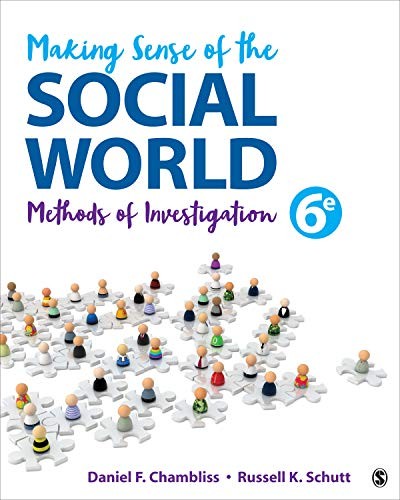
Making Sense of the Social World: Methods of Investigation 6th Edition
Master social research methods with this bestselling 6th edition—clear, practical, and packed with real-world examples. Get your digital copy today.
$10.99$23.00
Why This Book Matters
Social research can feel overwhelming. Whether you are designing a survey, conducting interviews, or analyzing statistical data, the challenge is not just knowing the methods—it is knowing which method to use and when. Making Sense of the Social World: Methods of Investigation cuts through the confusion by providing a clear, step-by-step framework for conducting rigorous social science research.
This book solves the core problem every student and researcher faces: how to move from a vague research question to a valid, actionable study design. It bridges the gap between abstract theory and practical application, making complex concepts accessible without oversimplifying them.
What Is Making Sense of the Social World: Methods of Investigation 6th Edition? A Complete Overview
Making Sense of the Social World: Methods of Investigation is the bestselling textbook by Daniel F. Chambliss and Russell K. Schutt, now in its Sixth Edition (2019). Published by SAGE Publications, Inc., this comprehensive guide covers the full spectrum of social research methods—from qualitative fieldwork to quantitative analysis.
The book is structured to mirror the actual research process, walking readers through problem formulation, research design, data collection, analysis, and reporting. Each chapter includes real-world examples, such as election polling and program evaluation, that illustrate how methods are applied in practice. This edition updates key examples and incorporates the latest developments in research ethics and technology.
Is This Book Right for You?
This textbook is designed primarily for undergraduate and graduate students enrolled in introductory social research methods courses across sociology, criminology, political science, social work, and related fields. It is equally valuable for early-career researchers who need a refresher on best practices.
Professionals in public policy, non-profit evaluation, and market research will also find the practical frameworks immediately useful. The book assumes no prior expertise in statistics or research design, making it accessible to newcomers while still offering depth for more experienced readers. If you need to understand how to gather and interpret social data credibly, this book is for you.
What You Will Learn
By working through this text, you will master the essential skills of social research. Here are the core competencies you will develop:
- Formulating research questions that are specific, testable, and ethically sound
- Designing research studies using experiments, surveys, field research, and mixed methods
- Sampling techniques to select representative participants from any population
- Measuring concepts with valid and reliable instruments
- Analyzing qualitative data through coding, theme identification, and narrative analysis
- Interpreting quantitative data using descriptive and inferential statistics
- Writing research reports that communicate findings clearly and ethically
Why This Book Stands Out
Unlike many methods textbooks that treat qualitative and quantitative approaches as separate worlds, Chambliss and Schutt integrate them seamlessly. The book demonstrates how each method complements the other, giving students a holistic understanding of research design.
Competing texts like Babbie’s The Practice of Social Research or Neuman’s Social Research Methods often overwhelm readers with dense theory. This book stands out by prioritizing clarity and real-world relevance. Each chapter opens with a concrete research example—such as how polling errors occur—and uses that example to teach the underlying methodological principle. This case-based approach dramatically improves retention and application.
The Sixth Edition also includes updated coverage of research ethics, online data collection, and big data, topics that are increasingly central to modern social science. No other introductory text balances breadth, depth, and accessibility as effectively.
Author & Publisher Credentials
Daniel F. Chambliss is the Eugene M. Tobin Distinguished Professor of Sociology at Hamilton College, where he has taught research methods for decades. He is the author of multiple award-winning books on qualitative methods and has published extensively in leading sociological journals.
Russell K. Schutt is Professor of Sociology at the University of Massachusetts Boston and a Lecturer in Psychiatry at Harvard Medical School. His research focuses on mental health services and program evaluation, bringing a practitioner’s perspective to methodological instruction.
SAGE Publications, Inc. is the world’s leading independent academic publisher of social science textbooks. Known for rigorous peer review and pedagogical excellence, SAGE has published countless foundational works in research methodology. This institutional backing ensures the content meets the highest standards of accuracy and currency.
Final Assessment
Absolutely. For any student or professional seeking a trustworthy, comprehensive introduction to social research methods, this textbook is the gold standard. Its Sixth Edition remains current with contemporary research practices, and the authors’ clear writing style makes even challenging topics digestible.
The book’s integration of qualitative and quantitative approaches is its greatest strength. Instead of treating them as competing paradigms, Chambliss and Schutt show how they work together to produce richer, more valid findings. This pragmatic, non-dogmatic perspective is rare in methods textbooks and invaluable for real-world research.
If you are preparing for a research methods exam, designing your first study, or simply want to become a more critical consumer of social science claims, this book delivers exceptional value. It is an investment in your ability to think rigorously about evidence—a skill that pays dividends across any career.
Start Reading Making Sense of the Social World: Methods of Investigation 6th Edition Today
Stop struggling with fragmented explanations and confusing terminology. This Sixth Edition of Making Sense of the Social World gives you the complete, coherent toolkit you need to design and execute credible social research. Whether you are a student facing a methods course or a professional conducting program evaluations, this book will transform how you approach data.
Order your digital copy now and start building the research skills that set you apart. With SAGE’s trusted name behind it and the latest edition’s updated content, this is the definitive guide to making sense of the social world.
Related products

A History of Psychology 2nd Edition – Global & Inclusive
$8.99This 2nd edition covers the history of psychology, including philosophical origins, women, minorities, and a new clinical chapter. Order now!
$18.00-
Applied Sport Psychology 7e: Personal Growth to Peak
$8.00Achieve peak performance with Applied Sport Psychology 7e. Master proven psychological techniques for personal growth. Get your digital copy today.
$11.00 -
Generalist Social Work Practice: An Empowering Approach (8th Edition) – Pearson
$27.99Master empowerment-focused social work with this widely adopted 8th edition. Build client strengths, navigate multi-level systems, and pass your licensure exam with confidence.
$75.00 -
Clinical Assessment Workbook: Balancing Strengths and Differential Diagnosis 2nd Edition
$11.99Master clinical assessment with a strengths-based, DSM-5-aligned workbook. Hands-on cases and worksheets build differential diagnosis skills.
$30.00 -
Ethical, Legal, and Professional Issues in Counseling, 6th Ed
$17.99Master ethical practice with the 6th edition of Ethical, Legal, and Professional Issues in Counseling. Essential for students and professionals. Order today.
$49.00 -
Becoming a Helper 8th Edition – Marianne & Gerald Corey eBook
$27.99Start your helping career with Corey & Corey’s Becoming a Helper, 8th Edition eBook—self-reflection, ethics, diversity, and practical skills in one essential guide.
$69.00 -
Case Study Research and Applications: Design & Methods, 6e
$15.99Master case study research with the definitive Sixth Edition of Case Study Research and Applications: Design and Methods. Order now for instant access.
$35.00 -
A History of Modern Psychology, 5th Edition – C. James Goodwin
$18.99Goodwin’s 5th edition offers a comprehensive, engaging history of modern psychology. Perfect for students and professionals—get your digital copy now!
$54.00