
save
$35.00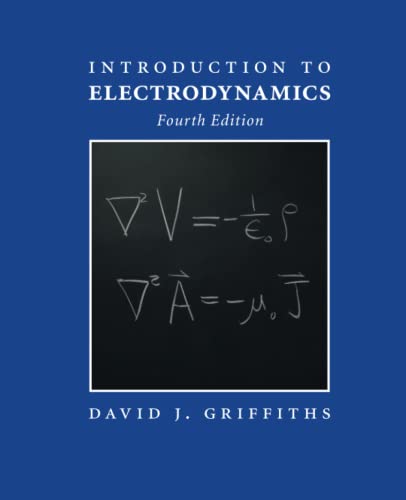
Introduction to Electrodynamics 4th Edition Griffiths
Master electrodynamics with Griffiths’s Fourth Edition—the clearest, most trusted undergraduate textbook from Cambridge University Press. Get your copy now.
Want to preview before you buy? Click Request Free Sample and tell us which chapter or pages you’d like to see, along with your email address. We’ll send you those pages from the eBook so you can be sure it’s the right one before buying.
- Instant download & lifetime access Available as soon as your payment is confirmed. Your download link is also sent to the email address you provide at checkout, and you can download your purchased eBook anytime from My Account → Downloads with unlimited downloads. An account is created automatically using the same email address.
- Own your eBook Receive the available PDF/EPUB file directly after purchase. No rental or temporary access — download and keep your eBook for personal use with lifetime access.
- Full refund guarantee If the eBook you receive does not match the details and description provided on the product page, contact [email protected] and we’ll issue a full refund within 24 hours.
- Secure payment through PayPal Pay securely by debit or credit card or with your PayPal account. Your card details are processed by PayPal and are never stored on our site.
$28.00$63.00
The Gap This Book Fills
Electromagnetism is the backbone of modern physics, yet many students struggle to bridge the gap between abstract Maxwell’s equations and real-world applications. Standard textbooks often bury readers in mathematical formalism without building physical intuition, leaving them unable to solve practical problems in electrostatics, magnetostatics, or electromagnetic waves. Introduction to Electrodynamics by David J. Griffiths directly addresses this gap by combining rigorous derivations with clear conceptual explanations and hundreds of worked examples. This Fourth Edition from Cambridge University Press (2017) has become the definitive undergraduate text because it teaches you not just the math, but the physics behind the math.
Whether you are an undergraduate physics major, an engineering student, or a self-learner preparing for graduate-level work, this book solves the core problem: how to truly understand electrodynamics rather than just memorize formulas. Griffiths’s conversational tone and systematic approach turn a notoriously difficult subject into an accessible, even enjoyable, learning experience.
Introduction to Electrodynamics 4th Edition Griffiths at a Glance
Introduction to Electrodynamics is a comprehensive undergraduate textbook that covers the full spectrum of classical electrodynamics, from the fundamentals of vector calculus to advanced topics like radiation and relativity. Authored by David J. Griffiths, a renowned physicist and educator at Reed College, this Fourth Edition represents the culmination of decades of teaching experience. Published by Cambridge University Press in 2017, it features a clean, readable layout with over 500 pages of carefully structured content.
The book is organized into 12 chapters that build logically from basic principles to sophisticated applications. Key topics include:
- Vector analysis and mathematical foundations essential for electrodynamics
- Electrostatics in vacuum and dielectric media
- Magnetostatics and magnetic fields in matter
- Maxwell’s equations in all their forms
- Electromagnetic waves, reflection, and refraction
- Potentials and fields, including gauge transformations
- Radiation from moving charges and antennas
- Special relativity and relativistic electrodynamics
Each chapter concludes with a rich set of problems ranging from straightforward exercises to challenging applications that develop both computational skill and physical insight. The book also includes appendices on vector calculus, the Helmholtz theorem, and SI units, making it a self-contained reference.
Is This Book Right for You?
This textbook is designed primarily for upper-division undergraduate physics majors who have completed a year of introductory calculus-based physics and a semester of vector calculus. It is also widely used in first-year graduate courses as a review or supplement. Introduction to Electrodynamics serves multiple audiences effectively:
- Physics undergraduates taking their core electrodynamics sequence — this is the standard text at hundreds of universities worldwide
- Engineering students specializing in electromagnetics, antennas, or microwave engineering who need deep physical understanding
- Graduate students preparing for qualifying exams or seeking a solid foundation before tackling Jackson’s Classical Electrodynamics
- Self-learners and independent researchers who want a clear, self-contained treatment of classical electromagnetism
- Instructors looking for a proven teaching resource with abundant problems and worked examples
The book’s approach assumes familiarity with basic calculus and Newtonian mechanics, but it carefully develops all necessary mathematical tools. Griffiths’s hallmark clarity makes it accessible even to motivated students encountering electrodynamics for the first time.
Inside: What You Will Master
Mastering electrodynamics requires both conceptual understanding and problem-solving skill. Here are the seven core competencies you will develop by working through Griffiths’s Fourth Edition:
- Vector calculus mastery — Gradient, divergence, curl, and the integral theorems become intuitive tools rather than abstract symbols
- Electrostatic problem-solving — Techniques including the method of images, separation of variables, and multipole expansion for real-world charge distributions
- Magnetostatic field calculation — Using the Biot-Savart law, Ampere’s law, and magnetic vector potential to compute fields from steady currents
- Maxwell’s equations in matter — Understanding how polarization and magnetization modify the fundamental equations, including boundary conditions
- Electromagnetic wave propagation — Deriving wave equations, analyzing reflection and transmission at interfaces, and understanding dispersion
- Radiation physics — Calculating fields from accelerating charges, understanding dipole radiation, and the Larmor formula
- Relativistic electrodynamics — How Maxwell’s equations transform under Lorentz transformations, and the unification of electric and magnetic fields
Each topic is reinforced with dozens of carefully graded problems that build confidence and deepen understanding. The solutions manual (available separately) provides complete derivations for all problems.
How It Compares
Several excellent electrodynamics textbooks exist, but Griffiths’s Fourth Edition has earned its reputation as the gold standard for undergraduate instruction. Here is how it compares to the competition:
vs. Jackson’s Classical Electrodynamics — Jackson is the definitive graduate-level reference, but its mathematical sophistication and dense presentation overwhelm most undergraduates. Griffiths provides the same physical depth at a more accessible level, making it the ideal stepping stone before tackling Jackson.
vs. Purcell and Morin’s Electricity and Magnetism — Purcell offers exceptional physical insight but uses Gaussian units throughout, which can confuse students who need SI unit fluency. Griffiths uses SI units exclusively, aligning with modern engineering and physics practice.
vs. Wangsness’s Electromagnetic Fields — Wangsness is mathematically rigorous but lacks Griffiths’s pedagogical flair and extensive problem sets. Griffiths’s conversational style and humorous asides keep students engaged through difficult material.
vs. online resources like MIT OCW — While free lecture notes are valuable, they lack the coherence, problem sets, and polished exposition of a carefully crafted textbook. Griffiths provides a complete, self-contained learning system that online fragments cannot match.
The Fourth Edition specifically improves upon earlier versions with updated problems, clearer diagrams, and refined explanations throughout. Cambridge University Press’s production quality ensures durable binding and crisp printing that will survive years of use.
Behind the Book
David J. Griffiths is one of the most respected physics textbook authors of the modern era. A professor of physics at Reed College, he has spent decades teaching electrodynamics and quantum mechanics to generations of undergraduates. His other bestselling textbooks — including Introduction to Quantum Mechanics and Introduction to Elementary Particles — share the same pedagogical hallmarks: clear writing, physical intuition, and rigorous mathematics. Griffiths’s deep understanding of how students learn is evident on every page.
Cambridge University Press, founded in 1534, is the oldest publishing house in the world and a premier academic publisher. Their physics catalog includes landmark texts by Dirac, Landau, and Feynman. The Fourth Edition of Introduction to Electrodynamics benefits from Cambridge’s rigorous editorial standards, professional typesetting, and global distribution network. This partnership ensures that the book you receive meets the highest quality benchmarks.
The 2017 publication date means this edition incorporates decades of classroom feedback and corrections, making it the most polished and error-free version available. It includes modernized notation, updated references, and problems that reflect contemporary physics.
The Bottom Line
Absolutely. This is not just a textbook — it is an investment in your physics education that will pay dividends throughout your career. The Fourth Edition of Introduction to Electrodynamics is widely regarded as the best undergraduate electrodynamics text ever written, and for good reason. It transforms a daunting subject into something manageable and even enjoyable. The clarity of Griffiths’s exposition, the quality of the problems, and the depth of physical insight are unmatched at this level.
Students who work through this book thoroughly emerge with a genuine understanding of electrodynamics, not just the ability to plug numbers into formulas. They are well-prepared for graduate-level courses, research in electromagnetics, or professional engineering work. The book’s enduring popularity — with over a million copies sold across all editions — is the strongest testament to its effectiveness.
Compared to the cost of a single semester’s tuition, the price of this book is trivial. And unlike online PDFs of dubious legality and quality, a legitimate copy from Cambridge University Press guarantees correct pagination, clear diagrams, and access to the official solutions if desired. You are investing in your success.
Get Your Copy Today
Whether you are a physics undergraduate facing your first electromagnetism course, an engineering student who needs a solid theoretical foundation, or a self-directed learner determined to understand Maxwell’s equations at a deep level, Introduction to Electrodynamics Fourth Edition is the single most effective resource available. David J. Griffiths has distilled decades of teaching excellence into a book that makes electrodynamics accessible, intuitive, and even enjoyable. Cambridge University Press has produced it to the highest academic standards.
Don’t settle for fragmented online notes or outdated editions. Order your legitimate copy today and start building the physical intuition and problem-solving skills that will serve you for a lifetime. This is the textbook that top physics departments trust — join the generations of students who have learned electrodynamics the right way. Add to cart now and take the first step toward mastery.
Related products

The Grand Biocentric Design: How Life Creates Reality
$6.99The Grand Biocentric Design by Robert Lanza, M.D. reveals how life and consciousness create the universe—the most complete argument for biocentrism yet. Get the ebook now.
$13.00-
Lange’s Handbook of Chemistry, Seventeenth Edition
$8.00Lange’s Handbook of Chemistry, Seventeenth Edition — the definitive single-volume chemical reference with verified data on over 5,400 compounds. Get instant access to physical, thermodynamic, and safety data trusted by professionals. Order your digital copy now.
$12.00 -
A First Course in General Relativity (Third Edition) – Bernard Schutz
$25.00Master general relativity with Bernard Schutz’s classic third edition. Updated with gravitational wave discoveries, black holes, and cosmology. Over 300 exercises included.
$54.00 -
Mathematics for Physicists Textbook – Introductory Concepts and Methods
$27.99Master the mathematics essential for undergraduate physics with this comprehensive textbook by Altland & von Delft. Over 300 problems, worked examples, and online solutions.
$55.00 -
A City on Mars: Space Settlement Book
$6.99Buy ‘A City on Mars’ – the critical, witty investigation into whether we can actually settle space. Get the ebook now and discover the real challenges of space colonization.
$16.00 -
Classical Mechanics Textbook: A Brief Introduction with Problems
$8.99Master classical mechanics with step-by-step derivations and illustrative problems. This concise textbook by Shahen Hacyan (World Scientific, 2024) is your key to exam success.
$17.00 -
Problems and Solutions on Mechanics, 2nd Edition
$18.99Master 408 exam-level mechanics problems with complete solutions. The definitive preparation for PhD qualifying exams from World Scientific’s trusted series.
$40.00 -
Fundamentals of Physics, 12e Student Solutions Manual
$28.99Master every odd-numbered problem in Halliday Resnick Walker’s Fundamentals of Physics 12th ed with step-by-step solutions from Wiley’s official manual.
$64.00