save
$1.00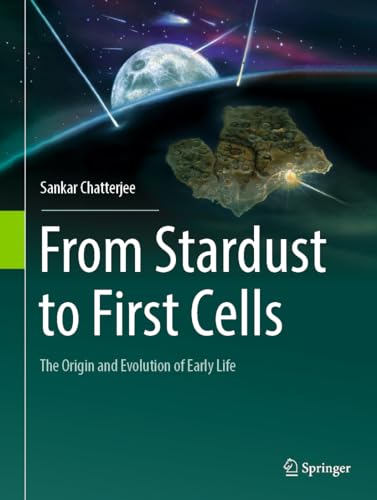
From Stardust to First Cells: The Origin and Evolution of Early Life
From Stardust to First Cells presents a groundbreaking hypothesis for the origin of life, integrating astrobiology, geology, and chemistry. Get the 2023 Springer Nature edition now.
$8.00$9.00
The Problem This Book Solves
How did life begin on Earth? This question has baffled scientists, philosophers, and thinkers for centuries. The gap between non-living chemistry and the first living cell remains the most profound mystery in natural science. From Stardust to First Cells tackles this exact problem with a bold, evidence-based hypothesis that bridges astronomy, geology, and biology.
Most books on the origin of life either focus narrowly on chemical evolution or drift into speculation. This work, by contrast, presents a coherent, testable narrative that connects cosmic events — from stellar nucleosynthesis to planetary formation — with the emergence of the first cellular organisms. If you have ever wondered how inanimate matter became alive, this book provides the most comprehensive answer available today.
From Stardust to First Cells: The Origin and Evolution of Early Life at a Glance
From Stardust to First Cells: The Origin and Evolution of Early Life is a 2023 scientific monograph published by Springer Nature Switzerland AG. Written by paleontologist and geoscientist Sankar Chatterjee, the book proposes that life originated through a series of deterministic steps, each driven by planetary chemistry and cosmic physics.
The book synthesizes evidence from multiple disciplines: astrophysics (the synthesis of organic molecules in space), geology (the formation of Earth’s early crust and oceans), and biochemistry (the self-assembly of protocells). Chatterjee’s central thesis is that life was not a freak accident but an inevitable outcome of Earth’s geochemical evolution. The volume is richly illustrated with diagrams, maps, and conceptual models that clarify complex processes.
Who Should Read This Book?
This book is designed for an intellectually curious audience that demands scientific rigor. It is not a pop-science summary but a detailed, referenced work suitable for advanced undergraduates, graduate students, and professional researchers in the earth and life sciences.
Specific readers who will benefit most include:
- Astrobiologists seeking a unified framework for life’s emergence on Earth and potentially other planets
- Geochemists and paleontologists interested in the Precambrian Earth and the fossil record of early life
- Evolutionary biologists who want to understand the pre-Darwinian steps that led to the Last Universal Common Ancestor (LUCA)
- Science educators looking for a clear, up-to-date synthesis of origin-of-life research
- Curious non-specialists with a strong background in basic chemistry and biology who want a serious, non-sensational treatment of the topic
Skills You Will Gain
Reading this book will transform your understanding of how life began. Here are the most important takeaways:
- The cosmic connection: How stardust — organic molecules formed in interstellar clouds and delivered by comets — provided the raw materials for life
- The RNA world hypothesis in context: How self-replicating RNA molecules may have emerged from prebiotic chemistry on early Earth
- The role of hydrothermal vents: Why deep-ocean alkaline vents are the most plausible site for the origin of protocells
- The transition from chemistry to biology: How lipid membranes, metabolism, and genetic information became coupled in the first cells
- The geological timeline: A step-by-step chronology from the Hadean eon through the Archean, when life first appeared
- The search for extraterrestrial life: How the principles in this book guide the search for life on Mars, Europa, and exoplanets
Why This Book Stands Out
Several books cover the origin of life, but none match the interdisciplinary breadth and intellectual coherence of Chatterjee’s work. Compared to Nick Lane’s The Vital Question, which focuses heavily on bioenergetics, this book gives equal weight to cosmic and geological context. Compared to Robert Hazen’s The Story of Earth, which emphasizes mineral evolution, Chatterjee’s book drills deeper into the specific chemical pathways that led to cells.
The 2023 edition from Springer Nature ensures that all references are current, including the latest findings from Mars rovers, laboratory simulations of prebiotic chemistry, and genomic studies of ancient microbial lineages. No other single volume integrates astronomy, geology, and biology at this level of detail while remaining accessible to a motivated reader.
Who Wrote This Book
Sankar Chatterjee is a Senior Curator of Paleontology at the Museum of Texas Tech University and a Professor of Geosciences. He has spent decades studying the fossil record of early life, including the Precambrian microfossils from the Gunflint Chert and the Bitter Springs Formation. His previous work on dinosaur evolution and plate tectonics earned him an international reputation for bold, data-driven hypotheses.
Springer Nature Switzerland AG is one of the world’s most respected academic publishers. Their peer-review process ensures that every claim in this book has been vetted by experts in astrobiology, geochemistry, and evolutionary biology. When you buy this Springer Nature title, you are getting scholarship that meets the highest standards of scientific rigor.
Our Verdict
For anyone serious about understanding the origin of life, this book is indispensable. It is not a light read — it demands concentration and a willingness to engage with technical material. But the payoff is enormous: a coherent, evidence-based narrative that connects the birth of stars to the birth of the first cells.
Where this book truly excels: Its integration of multiple scientific disciplines into a single, testable hypothesis. Where other works leave readers with more questions than answers, Chatterjee provides a clear, falsifiable framework. The 2023 publication date means it includes the most recent discoveries, from Martian organic molecules to laboratory-created protocells. For the price of a single textbook, you gain a reference that will inform your thinking for years.
Download From Stardust to First Cells: The Origin and Evolution of Early Life Now
Whether you are a student preparing for a career in astrobiology, a researcher looking for a unified hypothesis to guide your work, or a lifelong learner determined to understand the greatest scientific mystery, this book belongs on your shelf. The 2023 edition from Springer Nature is the definitive version — up-to-date, peer-reviewed, and written by one of the leading thinkers in the field.
Don’t wait. Add your copy of From Stardust to First Cells: The Origin and Evolution of Early Life to your cart now and start reading the most comprehensive account of life’s cosmic origins available today.
Related products

Mathematics for Physicists Textbook – Introductory Concepts and Methods
$19.99Master the mathematics essential for undergraduate physics with this comprehensive textbook by Altland & von Delft. Over 300 problems, worked examples, and online solutions.
$55.00-
Condensed Matter Field Theory 3rd Edition – Altland & Simons
$25.99Master quantum field theory for condensed matter with Altland & Simons’ updated third edition – functional integration, topological matter, and nonequilibrium physics.
$64.00 -
The Standard Model: From Fundamental Symmetries to Experimental Tests
$12.99Comprehensive graduate textbook on the Standard Model from symmetries to experiments. Essential for particle physics students. Buy now.
$26.00 -
Gator Country: Deception, Danger, and Alligators in the Everglades
$19.99Uncover the undercover sting that took on alligator poachers in the Everglades — a true story of deception, danger, and double agents.
$40.00 -
Classical Mechanics Textbook: A Brief Introduction with Problems
$11.99Master classical mechanics with step-by-step derivations and illustrative problems. This concise textbook by Shahen Hacyan (World Scientific, 2024) is your key to exam success.
$23.00 -
Astronomy 101: From the Sun and Moon to Wormholes and Warp Drive – Key Theories, Discoveries, and Facts About the Universe
$8.00Discover the universe in clear, engaging terms—from our solar system to wormholes and warp drive. Grab your copy of Astronomy 101 today and master the key theories and facts.
$9.00 -
Cambridge International AS and A Level Chemistry Coursebook
$21.99Get the complete Cambridge International AS & A Level Chemistry coursebook — covers syllabus 9701 for 2022 exams, with AS and A Level content. Buy now.
$65.00 -
A First Course in General Relativity (Third Edition) – Bernard Schutz
$15.99Master general relativity with Bernard Schutz’s classic third edition. Updated with gravitational wave discoveries, black holes, and cosmology. Over 300 exercises included.
$44.00