save
$13.01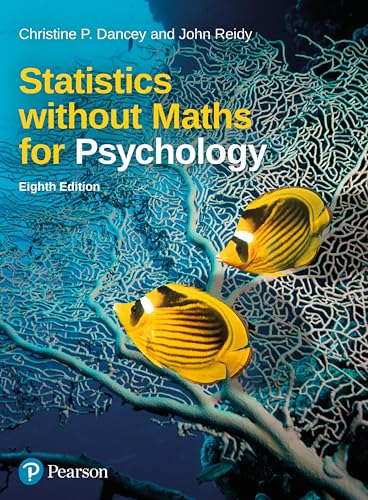
Statistics without Maths for Psychology 8th Edition
Master psychology statistics without formulas: this 8th edition guides you through SPSS step by step, building real understanding without the math anxiety.
Want to preview before you buy? Click Request Free Sample and tell us which chapter or pages you’d like to see, along with your email address. We’ll send you those pages from the eBook so you can be sure it’s the right one before buying.
- Instant download & lifetime access Available as soon as your payment is confirmed. Your download link is also sent to the email address you provide at checkout, and you can download your purchased eBook anytime from My Account → Downloads with unlimited downloads. An account is created automatically using the same email address.
- Own your eBook Receive the available PDF/EPUB file directly after purchase. No rental or temporary access — download and keep your eBook for personal use with lifetime access.
- Full refund guarantee If the eBook you receive does not match the details and description provided on the product page, contact [email protected] and we’ll issue a full refund within 24 hours.
- Secure payment through PayPal Pay securely by debit or credit card or with your PayPal account. Your card details are processed by PayPal and are never stored on our site.
$11.99$25.00
The Gap This Book Fills
Many psychology students feel a knot of anxiety when they hear the word “statistics.” Numerical formulas, probability distributions, and complex equations can turn a promising research methods course into a source of frustration. Statistics without Maths for Psychology directly addresses this fear by removing the mathematical barriers that keep students from understanding core statistical concepts. Instead of algebra and calculus, the book relies on clear language, intuitive explanations, and step-by-step guides to using SPSS—the most popular statistical software in the social sciences. Whether you are an undergraduate just beginning your research journey or a postgraduate seeking a refresher, this text transforms statistics from a dreaded prerequisite into an accessible tool.
About Statistics without Maths for Psychology 8th Edition
Statistics without Maths for Psychology (Eighth Edition, published by Pearson Education Limited in 2020) is a comprehensive textbook designed to teach psychological statistics through conceptual understanding rather than mathematical derivation. Authors Christine P. Dancey and John Reidy, both experienced psychology lecturers, have crafted a volume that has become a staple in undergraduate psychology programmes across the UK and beyond. The book covers the full range of statistical techniques required in psychological research—from descriptive statistics and t-tests to ANOVA, correlation, regression, and non-parametric methods—all without leaning on intimidating formulae. Each chapter is supplemented with detailed SPSS instructions, annotated output screenshots, and worked examples that connect statistical theory to real research questions. With 640 pages of clear, student-friendly content, this edition represents the latest refinement of a proven pedagogical approach.
Is This Book Right for You?
This book is written primarily for psychology undergraduates who need to pass a research methods and statistics module but lack strong mathematical backgrounds. It is equally valuable for graduate students in psychology, sociology, nursing, or other social science disciplines who want to strengthen their data analysis skills without getting lost in formulas. Lecturers and instructors who teach introductory statistics will find the book a useful framework for course design, and even seasoned researchers can benefit from the clear SPSS walkthroughs as a quick reference. The book is especially suited for learners who prefer visual and verbal explanations over symbolic equations, as well as for those who want to focus on interpreting statistical output rather than calculating it by hand.
What You Will Learn
By working through this textbook, you will master the following essential skills and concepts:
- Understanding levels of measurement and how they determine the appropriate statistical test
- How to enter, manipulate, and clean data in SPSS
- The logic of null hypothesis significance testing (NHST) and what p-values actually mean
- How to choose between parametric and non-parametric tests
- Performing and interpreting independent-samples and paired-samples t-tests
- Conducting one-way and factorial ANOVA, including post-hoc comparisons
- Correlation and regression analysis, including multiple regression basics
- How to report statistical results in APA style, with correct tables and figures
Each of these topics is presented in the context of real psychological research, so you see not just the how but the why behind the statistics.
How It Compares
Most introductory statistics textbooks follow a standard pattern: present a formula, show a worked example on a chalkboard, then assign practice problems. For students who are already comfortable with algebra, that approach works. But for the majority of psychology students—who chose the subject because they are interested in people, not numbers—the formula-first method creates an immediate barrier. Statistics without Maths for Psychology flips this model on its head. It begins with a research question, explains the purpose of a statistical test in plain English, and only then walks you through the SPSS steps needed to run it. Critically, it never asks you to compute a test statistic by hand. Instead, it trains you to read SPSS output, understand the numbers, and draw meaningful conclusions. Other popular texts like Field’s “Discovering Statistics Using IBM SPSS Statistics” offer a more humorous, example-rich approach, but they still contain a significant amount of mathematical notation. Dancey and Reidy’s book is the only major textbook that systematically strips out every equation while maintaining academic rigour. This makes it uniquely suitable for students who suffer from maths anxiety, international students who may struggle with terminology, or anyone who wants to concentrate on the logic of research design rather than arithmetic.
Author & Publisher Credentials
Christine P. Dancey is a Professor of Psychology at the University of East London, where she has taught research methods and statistics for over two decades. Her research focuses on health psychology, but she is best known for her innovative approach to statistics education. John Reidy is also a psychology lecturer at the same institution, with expertise in quantitative methods and sports psychology. Together, they have spent years refining the pedagogical principles that underpin this textbook—principles rooted in cognitive load theory and the need to reduce unnecessary complexity for learners. Pearson Education Limited is one of the world’s leading academic publishers, with a reputation for producing high-quality educational resources that comply with rigorous peer review standards. The Eighth Edition has been updated to reflect the latest version of SPSS and contemporary research practices, ensuring that students learn the most current methods.
Is It Worth It?
Yes, this textbook is an exceptional investment for any psychology student who struggles with mathematics or simply wants to focus on the big picture of data analysis. Its conceptual-first approach has been proven effective by years of classroom use and positive student feedback. The step-by-step SPSS guides are thorough enough to serve as a standalone manual, and the inclusion of multiple-choice questions, end-of-chapter exercises, and online resources makes it easy to self-study. While some instructors prefer a more mathematically rigorous text for honours or postgraduate courses, for the vast majority of undergraduate psychology programmes, this book delivers exactly what the title promises: statistics without the maths. The 8th edition is the most polished version yet, with improved clarity and updated references. If you are looking for a stress-free way to master psychological statistics, this book is your best option.
Add Statistics without Maths for Psychology 8th Edition to Your Library
Whether you are a first-year undergraduate trying to get through your research methods module or a PhD candidate who needs to quickly analyse a dataset, this book will save you hours of frustration. It gives you the confidence to tackle SPSS, the knowledge to interpret results correctly, and the skills to write up your findings in a professional manner. Stop letting complex formulas hold you back. Order your digital copy today from your preferred ebook retailer. This 2020 Eighth Edition from Pearson is the latest available—ensure you are learning from the most current version of a proven classic. Add to cart now and take the first step toward becoming a confident data analyst in psychology.
Related products

ACA Ethical Standards Casebook, 7th Edition – Barbara Herlihy & Gerald Corey
$29.00Master the 2014 ACA Code of Ethics with real-world case studies from leading experts Herlihy & Corey. The essential guide for ethical counseling practice.
$64.00-
Applied Sport Psychology 7e: Personal Growth to Peak
$29.99Achieve peak performance with Applied Sport Psychology 7e. Master proven psychological techniques for personal growth. Get your digital copy today.
$59.00 -
Generalist Social Work Practice: An Empowering Approach (8th Edition) – Pearson
$27.99Master empowerment-focused social work with this widely adopted 8th edition. Build client strengths, navigate multi-level systems, and pass your licensure exam with confidence.
$75.00 -
A History of Psychology 2nd Edition – Global & Inclusive
$54.99This 2nd edition covers the history of psychology, including philosophical origins, women, minorities, and a new clinical chapter. Order now!
$184.00 -
Data Baby: My Life in a Psychological Experiment – Susannah Breslin
$9.00In Data Baby, Susannah Breslin reveals her extraordinary life as a lab rat in a 30-year psychological study. Get your copy today!
$14.00 -
Generalist Practice with Organizations and Communities, 7th Edition — Empowerment Series Macro Social Work Textbook
$27.99Master macro social work with the leading textbook from the Empowerment Series. Learn to assess, intervene, and lead change in organizations and communities.
$71.00 -
American Government 101: Everything You Need to Know About U.S. Politics
$3.00Master US politics with American Government 101 – the concise, engaging guide to elections, the Constitution, and how government works. Order now!
$9.00 -
Unlearning Liberty: Campus Censorship, End of American Debate
$7.00Buy Unlearning Liberty by Greg Lukianoff and uncover how campus censorship threatens free speech and the future of American debate—get your copy now.
$15.00