save
$47.00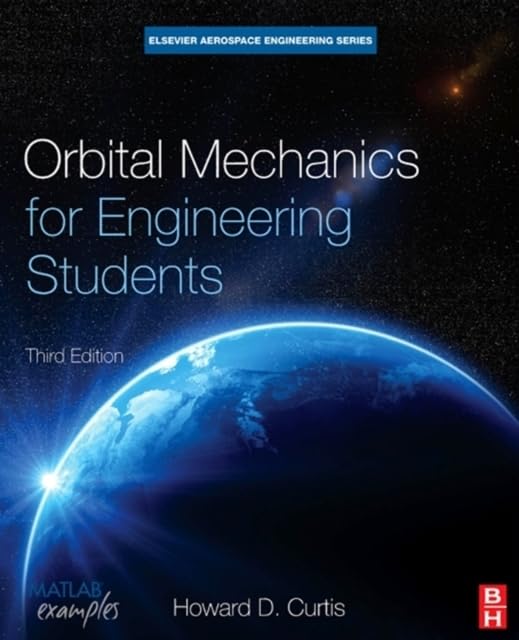
Orbital Mechanics for Engineering Students (Third Edition)
Buy Orbital Mechanics for Engineering Students, 3rd Edition. Essential aerospace engineering textbook with clear theory, MATLAB examples, and homework problems. Order now.
Want to preview before you buy? Click Request Free Sample and tell us which chapter or pages you’d like to see, along with your email address. We’ll send you those pages from the eBook so you can be sure it’s the right one before buying.
- Instant download & lifetime access Available as soon as your payment is confirmed. Your download link is also sent to the email address you provide at checkout, and you can download your purchased eBook anytime from My Account → Downloads with unlimited downloads. An account is created automatically using the same email address.
- Own your eBook Receive the available PDF/EPUB file directly after purchase. No rental or temporary access — download and keep your eBook for personal use with lifetime access.
- Full refund guarantee If the eBook you receive does not match the details and description provided on the product page, contact [email protected] and we’ll issue a full refund within 24 hours.
- Secure payment through PayPal Pay securely by debit or credit card or with your PayPal account. Your card details are processed by PayPal and are never stored on our site.
$31.00$78.00
The Problem This Book Solves
Aerospace engineering students often find orbital mechanics daunting due to its reliance on complex mathematics and abstract concepts. This textbook bridges the gap between theoretical physics and practical mission design, providing a step-by-step foundation that builds confidence and competence.
Inside Orbital Mechanics for Engineering Students (Third Edition): A Full Overview
Orbital Mechanics for Engineering Students is a premier textbook for undergraduate aerospace engineering programs. It introduces the fundamental principles of space mechanics, including vector kinematics, Newton’s laws of motion and gravitation, orbital position and velocity determination, trajectory analysis, and perturbation theory. The Third Edition (2014, Butterworth-Heinemann) incorporates new worked examples, updated homework exercises, and downloadable MATLAB code that brings abstract equations to life.
This edition covers both Earth-centered and interplanetary orbits, making it a versatile resource for courses in astrodynamics, spacecraft dynamics, and mission design.
Who Should Read This Book?
This book is written primarily for undergraduate students of aerospace engineering who are taking their first course in orbital mechanics. It is also an excellent reference for graduate students needing a refresher in the fundamentals, as well as practicing engineers in the aerospace industry who want to strengthen their understanding of orbital motion.
Instructors will appreciate the structured chapter organization, the clear learning objectives, and the extensive set of homework problems that reinforce key concepts.
Skills You Will Gain
- Vector kinematics and Newton’s laws applied to space mechanics
- The two-body problem and Keplerian orbital elements
- Orbital position and velocity from classical orbital elements and vice versa
- Trajectory design for interplanetary missions including Hohmann transfers and gravity assists
- Perturbation analysis: effects of Earth’s oblateness, atmospheric drag, and third-body interactions
- Numerical methods for orbit propagation using MATLAB
- Application of orbital mechanics to real-world satellite and spacecraft missions
Why Choose This Edition
While textbooks like Bate, Mueller, and White’s Fundamentals of Astrodynamics or Vallado’s Fundamentals of Astrodynamics and Applications offer depth, Curtis’s book stands out for its pedagogical clarity and modern approach. The Third Edition features extensive MATLAB examples that allow students to visualize orbits and solve problems computationally. Each chapter begins with clearly stated learning objectives and ends with a summary and a set of challenging homework exercises. The layout is consistently student-friendly, with margin notes, boxed equations, and bold-faced key terms that aid review. No other textbook at this level integrates programming so seamlessly into the learning process.
Author & Publisher Credentials
Howard D. Curtis is a professor of aerospace engineering at Embry-Riddle Aeronautical University, where he has taught orbital mechanics for decades. His deep academic experience ensures that the content is pedagogically sound and aligned with what students actually need. The publisher, Butterworth-Heinemann, is an imprint of Elsevier—a global leader in scientific and technical publishing. This combination of author expertise and publisher reputation guarantees a resource that is both authoritative and reliable.
Is It Worth It?
Absolutely. For any student serious about a career in aerospace engineering, this book is an essential investment. The clarity of the explanations, the abundance of worked examples, and the integrated MATLAB exercises give it a distinct advantage over older and more terse alternatives. It covers exactly the range of topics needed for a first course in orbital mechanics and prepares the reader for more advanced study or professional work. The Third Edition refines an already excellent text with additional problems and updated content. If you can own only one introductory orbital mechanics book, this should be it.
Start Reading Orbital Mechanics for Engineering Students (Third Edition) Today
You’ve compared the options, and this is the textbook that will give you the clearest path from Newton’s laws to real mission design. Whether you are an aerospace engineering student preparing for exams, a self-learner entering the field, or an instructor looking for a trusted class text, the Third Edition of Orbital Mechanics for Engineering Students delivers. Order your digital copy now and begin mastering the mathematics of spaceflight with a resource you’ll reference for years. Publisher: Butterworth-Heinemann (Elsevier), 2014.
Related products

Porous Metals: Preparation, Microstructure, Properties and Performance
$26.00Get the latest research on porous metals — fabrication, microstructure, properties, and performance — in this curated reprint of ten peer-reviewed papers edited by Yuyuan Zhao and Huiping Tang.
$56.00-
Practical Deep Learning for Cloud, Mobile, and Edge
$25.99Build and deploy production-ready deep learning applications for cloud, mobile, browser, and edge devices with this hands-on O’Reilly guide.
$51.00 -
Data-Driven Fluid Mechanics: Combining First Principles and Machine Learning
$25.00Combining first principles and machine learning, this data-driven fluid mechanics book is your essential guide for modern CFD research and practice.
$41.00 -
Structural Engineering Reference Manual (8th Edition)
$71.99Pass the NCEES 16-hour SE exam with the Structural Engineering Reference Manual, 8th Edition. Complete review of reinforced concrete, steel, timber, masonry, lateral forces, and bridge design.
$239.00 -
Fundamentals of Applied Electromagnetics 7th Edition – Ulaby & Ravaioli
$30.99Master electromagnetics with Ulaby & Ravaioli’s 7th edition — application-driven theory, Technology Briefs, and intuitive visuals for EE students and engineers.
$55.00 -
Engineering High Quality Medical Software: Regulations, Standards, Methodologies & Tools for Certification
$51.99Master medical software certification with this essential guide covering regulations, standards, and methodologies. Get your copy today.
$129.00 -
TinyML: Machine Learning with TensorFlow Lite on Arduino and Ultra-Low-Power Microcontrollers
$14.99Master TinyML with TensorFlow Lite on Arduino — deploy machine learning models on ultra-low-power microcontrollers with this hands-on guide.
$27.00 -
Delmar’s Standard Textbook of Electricity (8th Edition)
$37.99Master electrical theory with the industry-standard textbook. No prior experience needed. Get the 8th edition now.
$95.00