save
$53.01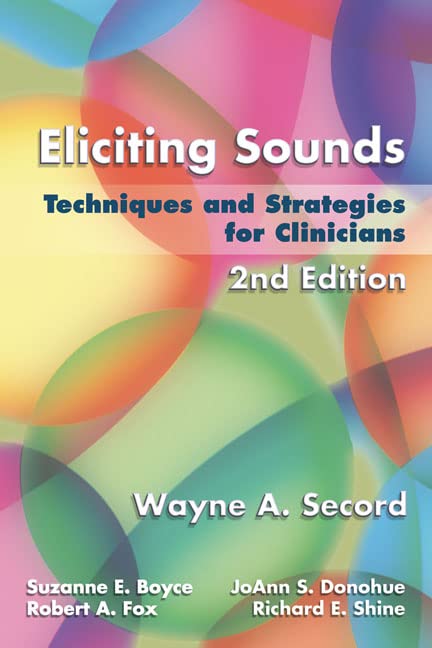
Eliciting Sounds: Techniques and Strategies for Clinicians 2nd Edition
Master every phoneme with proven elicitation techniques. This essential SLP reference gives you ready-to-use strategies for all English consonants, vowels, and diphthongs.
Want to preview before you buy? Click Request Free Sample and tell us which chapter or pages you’d like to see, along with your email address. We’ll send you those pages from the eBook so you can be sure it’s the right one before buying.
- Instant download & lifetime access Available as soon as your payment is confirmed. Your download link is also sent to the email address you provide at checkout, and you can download your purchased eBook anytime from My Account → Downloads with unlimited downloads. An account is created automatically using the same email address.
- Own your eBook Receive the available PDF/EPUB file directly after purchase. No rental or temporary access — download and keep your eBook for personal use with lifetime access.
- Full refund guarantee If the eBook you receive does not match the details and description provided on the product page, contact [email protected] and we’ll issue a full refund within 24 hours.
- Secure payment through PayPal Pay securely by debit or credit card or with your PayPal account. Your card details are processed by PayPal and are never stored on our site.
$33.99$87.00
Why This Book Matters
Speech-language pathologists (SLPs) face a persistent clinical challenge: how to elicit a specific phoneme when a client cannot produce it spontaneously. Standard articulatory approaches often fail with resistant or complex sound errors, leaving clinicians without a reliable next step. Eliciting Sounds: Techniques and Strategies for Clinicians addresses this gap directly by providing a structured, evidence-informed compendium of elicitation techniques for every consonant, vowel, and diphthong in English.
Whether you work with children who have phonological disorders, adults with apraxia, or clients with articulation delays, this 2nd edition offers ready-to-use strategies that save planning time and improve session outcomes.
What Is Eliciting Sounds: Techniques and Strategies for Clinicians 2nd Edition? A Complete Overview
Eliciting Sounds is a clinical reference text organized by target phoneme. For each sound, the book presents multiple elicitation techniques —including phonetic placement, shaping from a known sound, and facilitative contexts—along with troubleshooting guidance for common challenges. The spiral-bound format (in print) and well-structured digital version make it ideal for quick consultation during therapy sessions.
This 2nd edition, published by Delmar in 2007, represents a thorough update of the original work by Wayne A. Secord and his co-authors, all of whom bring substantial academic and clinical experience from institutions such as Ohio State University and the University of Central Florida. The book covers all English consonants, vowels, and diphthongs, with additional sections on vowel and consonant clusters.
Who Should Read This Book?
Eliciting Sounds is designed for practicing speech-language pathologists who need efficient, clinically proven techniques for sound production therapy. It is particularly valuable for:
- SLPs working in school settings with children who have articulation or phonological disorders
- Clinicians in rehabilitation or hospital settings serving clients with acquired apraxia or dysarthria
- Graduate students in speech-language pathology programs who are learning clinical phonetics and articulation therapy
- Clinical supervisors seeking a quick-reference tool for mentoring new therapists
- Researchers studying speech sound disorders who need a compendium of standard elicitation methods
The book assumes foundational knowledge of phonetics and typical/atypical speech development, so it is best suited for those with some clinical or academic training in speech-language pathology.
What You Will Learn
By using Eliciting Sounds, clinicians will gain practical strategies and conceptual knowledge that directly improve therapy delivery. Below are the core competencies developed through the book:
- Phonetic placement techniques for all English consonants—from bilabials to glottals—with specific tongue, jaw, and lip positioning instructions
- Shaping strategies that start from a familiar sound and gradually modify it into the target phoneme (e.g., /s/ from /t/)
- Facilitative contexts—identifying phonetic environments that naturally encourage correct production of a target sound
- Vowel production methods for monophthongs and diphthongs, including strategies for tense-lax distinctions
- Troubleshooting common errors such as lateralization, nasalization, or distortion, with specific remedial steps for each
- Incorporating phonemic awareness and motor learning principles into sound elicitation sessions
- Documenting and tracking progress using the technique-specific data collection suggestions provided throughout the text
Each section is self-contained, so the clinician can jump directly to the sound they need without reading sequentially.
How It Compares
While other clinical resources—such as Van Riper’s traditional approach or oral-motor exercise manuals—offer general guidance, Eliciting Sounds provides phoneme-by-phoneme specificity unmatched by any single volume. Competitor texts often describe articulatory features but stop short of offering multiple, sequenced elicitation procedures for each sound.
This book’s primary advantage is its structured, reproducible approach: for every target phoneme, you get not one but several techniques, ranked by difficulty or developmental appropriateness. For example, for eliciting /r/, the book presents a continuum from stimulability strategies to phonetic placement for retroflex and bunched variants. No other clinical manual offers this depth for so many sounds in one place.
Additionally, the authors’ collective expertise in phonetics, motor speech disorders, and clinical education ensures that every technique is grounded in both acoustic science and real-world feasibility. The 2nd edition has been updated to reflect current best practices in motor learning and feedback, making it more effective than earlier versions or generic articulation workbooks.
Behind the Book
The authorship team behind Eliciting Sounds combines decades of clinical research and practice. Wayne A. Secord is a well-known figure in speech-language pathology, having authored numerous textbooks and assessment tools, and he has held leadership roles at the University of Central Florida and the University of Cincinnati. Suzanne E. Boyce and Robert A. Fox bring deep expertise in acoustic phonetics and speech science from The Ohio State University, while JoAnn S. Donohue and Richard E. Shine contribute extensive clinical experience with children and adults. This blend of academic rigor and hands-on clinical insight makes the text exceptionally trustworthy.
The publisher, Delmar (a brand of Cengage Learning), is a respected name in allied health education, known for producing high-quality training materials for speech-language pathology, audiology, and nursing. Delmar ensures that the content meets professional accreditation standards and is reviewed by experts in the field. The ISBN 9781401897253 identifies this 2nd edition as a core resource in SLP curricula and clinical libraries.
Our Verdict
Eliciting Sounds is a must-have clinical reference for any SLP who regularly conducts articulation or phonological therapy. Its targeted, efficient design reduces preparation time and increases the likelihood of therapeutic success. Compared to the cost of a single private therapy session or the time spent searching the web for techniques, the book pays for itself quickly.
Clinicians who work with a broad caseload will find it particularly valuable because it covers both common sounds (e.g., /s/, /l/, /r/) and less frequently targeted ones (e.g., /ʒ/, /θ/, /ð/). The careful organization by phoneme and the inclusion of multiple elicitation strategies for each sound means you are never left without a plan B when a typical approach fails.
The only limitation is that the book is specifically a technique compendium—it does not cover comprehensive assessment, treatment planning, or carryover activities. For those broader needs, it should be supplemented with a full articulation or phonology textbook. However, as a daily clinical quick-reference for sound elicitation, it has no equal.
With an affordable digital price compared to the print spiral-bound edition ($185.95 new), the eBook version offers the same clinical utility with the added convenience of searchable, portable access on your device.
Add Eliciting Sounds: Techniques and Strategies for Clinicians 2nd Edition to Your Library
Download the eBook now and add a proven clinical tool to your SLP library. Whether you are a graduate student building your clinical repertoire or a seasoned practitioner looking for fresh techniques, this 2nd edition delivers practical solutions you can use immediately. When a child or adult client struggles to produce even a single sound, having a structured menu of elicitation strategies at your fingertips can make all the difference in therapy outcomes. Order your copy of Eliciting Sounds: Techniques and Strategies for Clinicians today and see how quickly you can turn clinical frustration into breakthrough progress.
Related products

Antibiotic Drug Resistance (1st ed.)
$64.99Comprehensive guide to antibiotic drug resistance mechanisms, clinical impact, and solutions. Ideal for researchers and clinicians. Order now.
$185.00-
General Thoracic Surgery, 7th Edition
$59.99Get the 7th edition General Thoracic Surgery eBook – the comprehensive two-volume guide to all open and endoscopic thoracic surgical procedures.
$149.00 -
Epilepsy: A Queen Square Textbook (First Edition) – Comprehensive Adult Epilepsy Guide
$40.99The authoritative first edition from Queen Square experts—your essential resource for mastering epilepsy diagnosis and management.
$105.00 -
Handbook of MRI Scanning: Step-by-Step Protocols for Diagnostic Imaging
$19.00Master MRI scanning with this practical handbook by Burghart and Finn. Step-by-step protocols for high-quality diagnostic images. Order your copy today!
$43.00 -
Botulinum Toxin Procedures: A Practical Guide to – eBook
$35.99Master Botulinum Toxin Procedures with this practical guide. Step-by-step instructions, anatomy, and patient selection for safe, effective treatments.
$102.00 -
Essentials of Epidemiology in Public Health, Fourth Edition
$25.99Master epidemiologic methods with this essential Fourth Edition textbook from Jones & Bartlett Learning, perfect for public health students and professionals.
$78.00 -
Farquharson’s Textbook of Operative General Surgery 11th Ed
$40.99Master operative surgery with the Eleventh Edition of Farquharson’s essential textbook for surgical trainees, featuring 490 color illustrations and expert guidance.
$91.00 -
Handbook of Forensic Drug Analysis – Comprehensive Chemical Reference
$13.99Get the essential Handbook of Forensic Drug Analysis, the definitive chemical reference for identifying and analyzing illicit substances in forensic labs.
$25.00