save
$38.01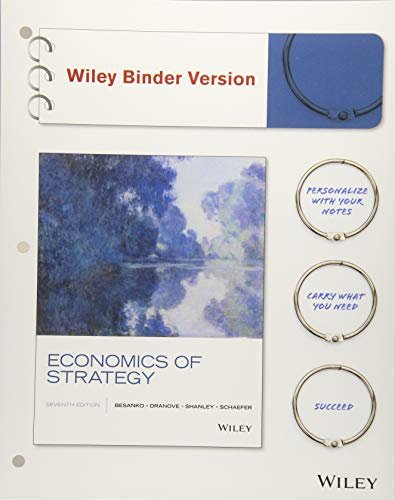
Economics of Strategy 7th Edition by Besanko, Dranove
Master strategic decision-making with Economics of Strategy 7e. Essential reading for MBA students and business professionals. Get your digital copy now.
$20.99$59.00
The Problem This Book Solves
In today’s hypercompetitive markets, business leaders and MBA students face a persistent challenge: how to translate high-level economic theory into actionable strategic decisions. The gap between abstract models from game theory and the messy realities of pricing, vertical integration, and differentiation is where many strategies falter. Economics of Strategy bridges this gap by offering a rigorous yet accessible framework that connects microeconomic principles directly to the strategic choices managers make every day.
Unlike traditional strategy texts that emphasize anecdotal case studies, or pure economics texts that neglect implementation, this 7th edition delivers a balanced synthesis. It equips readers with the analytical tools to evaluate market structure, anticipate competitor moves, and design organizational structures that sustain competitive advantage. Whether you are a student preparing for a consulting career or a seasoned executive refining your firm’s strategy, this book provides the conceptual foundation you need.
What Is Economics of Strategy? A Complete Overview
Economics of Strategy is a leading business strategy textbook authored by David Besanko, David Dranove, Mark Shanley, and Scott Schaefer. Published by John Wiley & Sons in its seventh edition (2016), the book focuses on the key economic concepts that students must master to develop sound business strategies. It captures the breadth of Sharon Oster’s classic strategic analysis while approaching the rigor of Milgrom and Roberts’s economics of organization, all enriched with real-world illustrative examples.
The text covers foundational topics such as economies of scale, scope, and learning; the economics of vertical integration; strategic positioning; pricing strategies; entry and exit barriers; and the role of information in competitive dynamics. Each chapter integrates mathematical models where necessary but emphasizes intuitive explanations and managerial applications. The 7th edition updates examples and data to reflect current market realities, ensuring relevance for today’s decision-makers.
Who Should Read Economics of Strategy?
This book is designed for graduate-level business students, particularly those enrolled in MBA programs focusing on strategy, consulting, or general management. It is also highly suitable for executive education courses and self-study by professionals seeking to deepen their understanding of strategic decision-making.
Specifically, Economics of Strategy is ideal for:
- MBA students taking core or elective courses in competitive strategy, strategic management, or managerial economics.
- Consultants and analysts who need to apply economic frameworks to client problems in market entry, pricing, and supply chain design.
- Entrepreneurs looking to analyze industry structure and identify sustainable competitive positions.
- Senior managers responsible for corporate strategy, business development, or M&A who want a rigorous yet practical toolkit.
- Academic researchers seeking a comprehensive reference on the economic foundations of strategy.
- Anyone preparing for case interviews or strategy case competitions where economic logic is critical.
7 Key Things You Will Learn
By studying Economics of Strategy, readers gain mastery over the following essential domains:
- The Economics of Market Structure: How to analyze industry concentration, entry barriers, and the forces shaping competition using tools like the Herfindahl-Hirschman Index.
- Strategic Positioning and Differentiation: How firms can create value through cost leadership, differentiation, and focus strategies, and how to sustain these positions against imitation.
- Pricing and Non-Price Competition: The logic behind price discrimination, bundling, tie-in sales, and signaling in markets with asymmetric information.
- Vertical Integration and Outsourcing: When to integrate upstream or downstream versus rely on contracts, and how transaction costs influence governance choices.
- Game Theory in Action: Using simultaneous and sequential games to model competitive interactions, including price wars, advertising battles, and technology adoption.
- Organizational Economics: Understanding the internal organization of firms, including incentive design, delegation, and the boundaries of the firm.
- Dynamic Strategy and Innovation: How firms manage innovation, network effects, and platform competition in technology-driven markets.
Why Economics of Strategy Outperforms Every Alternative
Many strategy textbooks focus either on qualitative frameworks (like Porter’s Five Forces or the SWOT analysis) or on pure microeconomic theory with minimal business context. Economics of Strategy uniquely integrates both. While Porter’s Competitive Strategy provides a valuable starting point, it lacks the formal economic rigor needed to anticipate competitor behavior quantitatively. On the other hand, texts like Microeconomics by Pindyck & Rubinfeld offer thorough economic analysis but do not connect it to strategic decision-making.
The authors — Besanko, Dranove, Shanley, and Schaefer — bring decades of research and teaching experience to the table. Their approach is specifically calibrated to the needs of business students who may not have deep economics backgrounds. The 7th edition updates industry examples and incorporates the latest research on strategic behavior, making it more current than older editions of competing titles. No other book in this space combines Oster’s breadth with the analytical depth of Milgrom & Roberts while remaining accessible to MBA audiences.
Author Authority & Publisher Credibility
David Besanko, David Dranove, Mark Shanley, and Scott Schaefer are leading scholars in the fields of industrial organization, strategy, and organizational economics. Their academic contributions appear in top journals, and they bring decades of teaching experience to this textbook. The authors’ stated objective — to combine the breadth of Oster with the analytical depth of Milgrom and Roberts — demonstrates their ambition to create a definitive resource for students and practitioners.
Published by John Wiley & Sons, a premier academic publisher since 1807, this 7th edition has undergone rigorous peer review and editorial scrutiny. The book’s extensive adoption in MBA programs worldwide speaks to its credibility and effectiveness. The 2016 publication date ensures that the content reflects contemporary market dynamics and strategic thinking.
Is Economics of Strategy Worth It? Our Verdict
Absolutely. For anyone serious about mastering the economic logic behind successful business strategy, this book is indispensable. It is not a light read — it demands engagement with formal models and analytical reasoning — but the payoff is a deeply integrated understanding of how firms compete and win. The 7th edition’s updated examples and exercises ensure that the content remains relevant to contemporary business challenges.
Compared to alternatives, Economics of Strategy stands out for its balance of breadth and depth. It covers more ground than Porter’s classic while offering more strategic focus than a standard microeconomics text. The book’s structure allows readers to progress from fundamental concepts to advanced applications seamlessly. Whether you use it as a course text or a self-study resource, you will come away with a durable mental framework for strategic analysis.
Given its adoption at leading business schools and the stellar reputation of its authors, this is a low-risk investment in your professional development. The knowledge gained here will serve you for years, whether you work in consulting, corporate strategy, or entrepreneurship.
Get Economics of Strategy — Master the Economics Behind Winning Strategies
Your ability to think strategically — grounded in rigorous economic reasoning — is your most valuable competitive advantage. Economics of Strategy, 7th Edition delivers the analytical framework you need to analyze markets, anticipate competitors, and design winning strategies.
Whether you are an MBA student preparing for a strategy exam, a consultant building client recommendations, or a business leader shaping your company’s direction, this book is your essential guide. Act now to secure this current edition before it becomes unavailable. With the expertise of Besanko, Dranove, Shanley, and Schaefer, backed by the renowned publisher John Wiley & Sons (2016), you are investing in proven knowledge.
Add to cart today and start applying economics to strategy with confidence.
Related products

Budgeting 101: From Getting Out of Debt to Building Savings — Your Essential Guide
$8.00Master budgeting basics with this Simon & Schuster guide: get out of debt, track expenses, and build savings — start your financial transformation now.
$13.00
Business Law 11th Edition eBook by Henry R. Cheeseman – Pearson
$14.00Get the Business Law 11th Edition ebook by Henry R. Cheeseman. Master legal concepts with real case studies. Instant digital access from Pearson. Buy today and excel in your course or career.
$25.00-
Fundamentals of Management, 8th Edition – Ricky W. Griffin
$12.99Master management fundamentals with Griffin’s 8th edition: real-world cases, skills-based approach, and instant digital access. Buy the eBook today.
$30.00 -
Airlines in a Post-Pandemic World: Preparing for Constant Turbulence Ahead
$29.99Master post-pandemic airline strategy with Nawal K. Taneja’s essential guide to building resilience against constant disruption. Order your copy today.
$67.00 -
Personal Finance 101: Master Budgeting, Saving & Debt Management
$8.00Personal Finance 101: The all-in-one guide to budgeting, debt relief, saving, and retirement planning—simple, practical, and from Simon & Schuster. Take control of your money now.
$14.00 -
Data Science for Business: Master Data-Analytic Thinking
$16.99Master data-analytic thinking with this essential guide. Understand data science principles to drive business decisions. Get your copy today.
$51.00 -
Business and Society: Stakeholders, Ethics, Public Policy 16th Edition
$12.99Order the 16th edition of Business and Society: Stakeholders, Ethics, Public Policy by Lawrence & Weber. Essential for business ethics courses. Download now.
$30.00 -
Business & Society: Ethics, Sustainability, and Stakeholder Management 10th Edition
$10.99Master business ethics, sustainability, and stakeholder management with this authoritative Tenth Edition textbook from Cengage Learning — order your copy today.
$21.00