save
$12.01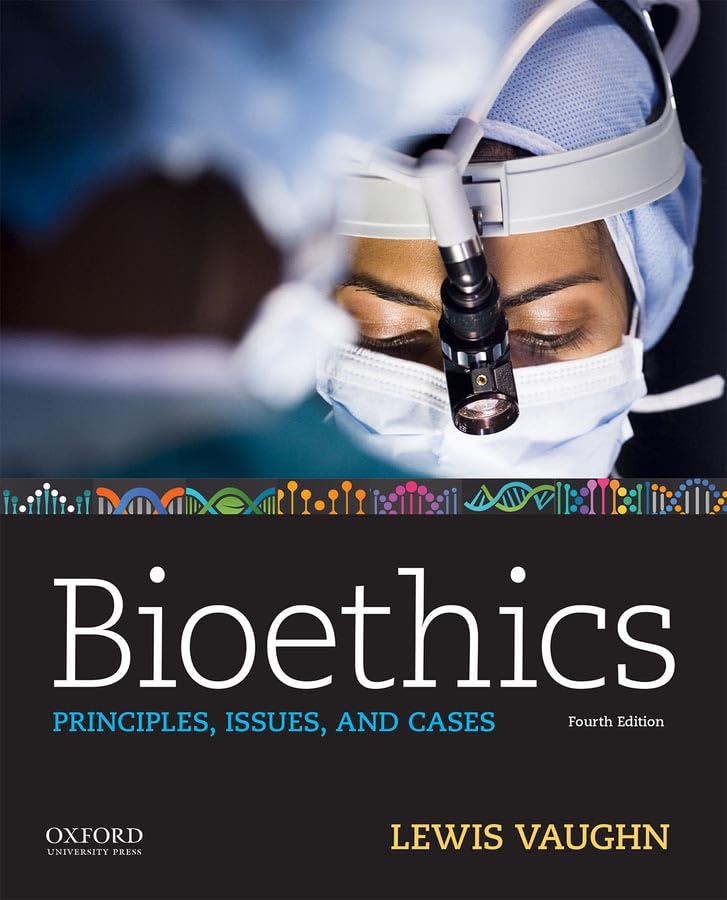
Bioethics: Principles, Issues, and Cases 4th Edition
Master bioethics with the Fourth Edition of Lewis Vaughn’s comprehensive textbook, blending philosophical principles, real-world cases, and medical, social, and legal perspectives.
Want to preview before you buy? Click Request Free Sample and tell us which chapter or pages you’d like to see, along with your email address. We’ll send you those pages from the eBook so you can be sure it’s the right one before buying.
- Instant download & lifetime access Available as soon as your payment is confirmed. Your download link is also sent to the email address you provide at checkout, and you can download your purchased eBook anytime from My Account → Downloads with unlimited downloads. An account is created automatically using the same email address.
- Own your eBook Receive the available PDF/EPUB file directly after purchase. No rental or temporary access — download and keep your eBook for personal use with lifetime access.
- Full refund guarantee If the eBook you receive does not match the details and description provided on the product page, contact [email protected] and we’ll issue a full refund within 24 hours.
- Secure payment through PayPal Pay securely by debit or credit card or with your PayPal account. Your card details are processed by PayPal and are never stored on our site.
$17.99$30.00
The Problem This Book Solves
Every day, healthcare professionals, researchers, and policymakers confront ethical dilemmas that demand rigorous analysis—from end-of-life decisions to genetic engineering, from resource allocation to patient autonomy. Without a structured framework, these decisions can be inconsistent, biased, or morally indefensible. Bioethics: Principles, Issues, and Cases provides the essential theoretical grounding and practical case-based reasoning to navigate these complex challenges with clarity and confidence.
This fourth edition, published by Oxford University Press in 2020, systematically addresses the philosophical, medical, social, and legal dimensions of contemporary bioethics, ensuring readers are equipped to handle the most pressing issues of our time.
Bioethics: Principles, Issues, and Cases 4th Edition at a Glance
Bioethics: Principles, Issues, and Cases is a comprehensive textbook that integrates moral theory with real-world medical and research contexts. Author Lewis Vaughn structures the book around three core pillars: the foundational principles of bioethics (autonomy, beneficence, nonmaleficence, justice), the major ethical issues that arise in healthcare and research, and the landmark cases that have shaped the field.
The text is organized to build understanding progressively: Part I introduces ethical reasoning and the major moral theories; Part II applies these theories to specific issues such as abortion, euthanasia, reproductive technology, and genetic engineering; and Part III presents extended case studies for deeper analysis. Each chapter includes learning objectives, discussion questions, and updated references to current literature.
Who Is This Book For?
This textbook is designed for undergraduate and graduate students in bioethics, philosophy, medicine, nursing, law, and public health. It is equally valuable for practicing healthcare professionals seeking to strengthen their ethical decision-making skills and for anyone engaged in health policy or medical research.
Specifically, the book is ideal for:
- Students enrolled in bioethics courses who need a clear, structured introduction to the subject
- Medical and nursing students preparing for clinical ethics rotations and board exams
- Philosophy majors exploring applied ethics through real-world cases
- Legal professionals working in health law, medical malpractice, or regulatory compliance
- Healthcare administrators and policymakers who must balance ethical principles with institutional constraints
Key Takeaways
By working through this text, readers will gain a robust understanding of bioethics and its practical applications. The key learning outcomes include:
- The four fundamental principles of bioethics—autonomy, beneficence, nonmaleficence, and justice—and how to apply them in clinical and research settings
- Major ethical theories (utilitarianism, deontology, virtue ethics, and principlism) and their relevance to bioethical controversies
- How to analyze landmark legal cases such as Roe v. Wade, Cruzan v. Director, and the Tuskegee Syphilis Study, extracting their ethical lessons
- Contemporary issues in reproductive ethics, including abortion, surrogacy, and genetic screening
- End-of-life care debates covering advance directives, physician-assisted suicide, and palliative sedation
- Research ethics, including informed consent, institutional review boards, and the ethics of human and animal experimentation
- Public health ethics challenges such as mandatory vaccination, resource allocation during pandemics, and health disparities
What Sets It Apart
Unlike many bioethics textbooks that present theory in isolation, Vaughn’s book consistently pairs each principle and issue with concrete, real-world cases. This approach ensures that readers not only understand the concepts but can also apply them to scenarios they will encounter in practice. The fourth edition includes updated discussions on emerging topics like CRISPR gene editing, artificial intelligence in medicine, and global health ethics.
Other textbooks often rely solely on philosophical abstraction or anecdotal examples. Vaughn, however, provides a balanced integration of philosophical rigor, medical accuracy, and legal context. The book’s pedagogical structure—with clear chapter objectives, end-of-chapter questions, and a companion website with additional resources—makes it easier to study and retain material. Additionally, the Oxford University Press imprint guarantees a rigorous peer-review process and authoritative content.
About the Author
Lewis Vaughn is a recognized author of numerous philosophy textbooks, including Philosophy Here and Now and The Power of Critical Thinking. His expertise in ethics and critical thinking is evident in the clarity and depth of this text. Vaughn’s ability to distill complex philosophical ideas into accessible prose without sacrificing intellectual honesty makes him a trusted guide for students and professionals alike.
Oxford University Press is one of the world’s leading academic publishers, known for its commitment to scholarly excellence. The fourth edition of Bioethics: Principles, Issues, and Cases underwent a thorough editorial review, ensuring that all content is accurate, up-to-date, and pedagogically sound. This combination of author expertise and publisher prestige provides readers with a resource they can rely on for both coursework and professional reference.
Our Verdict
Absolutely. For anyone seeking a comprehensive, well-organized, and practical introduction to bioethics, this textbook is the gold standard. Its balanced treatment of theory and application, its inclusion of landmark cases, and its coverage of cutting-edge issues make it a valuable investment for a student’s entire academic career and beyond. The fourth edition’s updates ensure that it remains relevant in a rapidly evolving field.
Compared to other options, such as Beauchamp and Childress’s Principles of Biomedical Ethics (which is more advanced and theoretical) or Tom L. Beauchamp’s Contemporary Issues in Bioethics (which is less structured), Vaughn’s book offers the most accessible yet comprehensive entry point. It is specifically designed to support learning in a semester-long course, with clear chapter organization and built-in assessment tools.
Get Your Copy Today
Whether you are a student preparing for a career in medicine, a professional seeking to deepen your ethical reasoning, or a researcher navigating the complexities of informed consent, this book is your essential companion. The Fourth Edition from Oxford University Press delivers the most current and comprehensive coverage of bioethics available.
Add this indispensable resource to your cart today and gain the confidence to make ethically sound decisions in any healthcare or research setting. With Lewis Vaughn’s clear guidance and the authority of Oxford University Press, you are investing in a lifelong skill set that will serve you and your patients well.
Related products

Davis’s Comprehensive Handbook of Laboratory & Diagnostic Tests, 8th Edition
$18.00Master every lab and diagnostic test with nursing implications you can trust. The 8th edition of Davis’s Comprehensive Handbook is your pocket-sized guide to accurate interpretation and safe patient care.
$33.00-
Handbook of MRI Scanning: Step-by-Step Protocols for Diagnostic Imaging
$19.00Master MRI scanning with this practical handbook by Burghart and Finn. Step-by-step protocols for high-quality diagnostic images. Order your copy today!
$43.00 -
Vascular Access: Principles and Practice 5th Edition – Comprehensive Textbook
$48.99Master all aspects of vascular access for hemodialysis, chemotherapy, nutrition, and critical care with this practical 5th edition textbook by Samuel Eric Wilson. Get the definitive how-to guide now.
$141.00 -
Essentials of Epidemiology in Public Health, Fourth Edition
$25.99Master epidemiologic methods with this essential Fourth Edition textbook from Jones & Bartlett Learning, perfect for public health students and professionals.
$78.00 -
Child and Adolescent Mental Health Screening, Evidence-Based Assessment, Intervention, and Health Promotion, 3rd Edition
$30.99The essential evidence-based guide for child and adolescent mental health screening, assessment, and intervention—updated third edition with practical tools and KySS framework.
$65.00 -
Guyton and Hall Textbook of Medical Physiology 15th Edition
$31.99Understand medical physiology with the clearest, most authoritative textbook. Guyton and Hall 15th edition explains how cells, tissues, and organs work together. Trusted by students and clinicians worldwide.
$81.00 -
Vascular Surgical Emergencies: Well-Prepared for Duty
$28.00Master 50 vascular surgical emergencies with proven diagnostic and therapeutic protocols. The 2026 Springer guide from Susanne Regus — essential for every vascular surgeon.
$49.00 -
Handbook of Forensic Drug Analysis – Comprehensive Chemical Reference
$13.99Get the essential Handbook of Forensic Drug Analysis, the definitive chemical reference for identifying and analyzing illicit substances in forensic labs.
$25.00