save
$23.01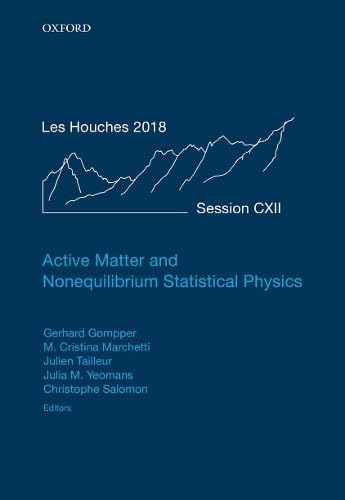
Active Matter and Nonequilibrium Statistical Physics – Les Houches Lecture Notes 2022
Master active matter theory with the authoritative Les Houches lecture notes—2022 Oxford University Press volume covering nonequilibrium statistical physics from leading experts.
$17.99$41.00
The Problem This Book Solves
Understanding the collective behavior of systems far from equilibrium—from bacterial swarms to cellular tissues—requires a theoretical framework that traditional thermodynamics cannot provide. Researchers and advanced students in statistical physics face a steep learning curve when transitioning from equilibrium theory to the active matter paradigm. This volume, drawn from the prestigious Les Houches Summer School, compresses that learning curve into a single authoritative resource.
Inside Active Matter and Nonequilibrium Statistical Physics – Les Houches Lecture Notes 2022: A Full Overview
Active Matter and Nonequilibrium Statistical Physics (Oxford University Press, 2022) is the lecture note collection of the Les Houches Summer School: Volume 112, held August 27–September 21, 2018. Edited by Gerhard Gompper, M. Cristina Marchetti, Julien Tailleur, Julia M. Yeomans, and Christophe Salomon, the book offers a pedagogical yet rigorous introduction to the statistical mechanics of active systems. It covers foundational principles alongside cutting-edge applications in biological physics, soft condensed matter, and nonequilibrium thermodynamics.
The volume is organized into self-contained lecture sets, each written by leading experts who taught at the school. Topics range from hydrodynamic theories of active fluids to the stochastic thermodynamics of molecular motors, making it equally valuable as a textbook for newcomers and a reference for seasoned practitioners.
Who Will Benefit Most
This book is designed for three distinct audiences:
- Graduate students in physics, biophysics, or engineering entering the field of active matter and needing a systematic foundation
- Postdoctoral researchers seeking a broad overview of modern nonequilibrium statistical physics methods
- Established scientists in condensed matter, soft matter, or biological physics who want to expand their toolkit to active systems
Prerequisites include a solid grasp of equilibrium statistical mechanics and basic fluid dynamics. The lecture format assumes a level of mathematical maturity typical of a first-year graduate physics curriculum.
Inside: What You Will Master
- Hydrodynamic theories of active fluids – including the Toner–Tu equations for polar flocks and the continuum description of active nematics
- Active Brownian particles – the minimal model for self-propelled colloids and its phase behavior
- Stochastic thermodynamics – fluctuation theorems, entropy production, and thermodynamic uncertainty relations in active systems
- Motility-induced phase separation – the mechanism by which purely self-propelled particles form dense clusters without attractive forces
- Active gels and cytoskeletal dynamics – how molecular motors and filaments generate contractility and flows in cells
- Bacterial active matter – collective motion in bacterial colonies, including turbulence and biofilm formation
- Topological defects in active systems – their role in active turbulence and tissue remodeling
- Numerical methods for active matter – simulation techniques such as lattice Boltzmann, molecular dynamics, and field-theoretic approaches
Why This Book Stands Out
Unlike standard textbooks on nonequilibrium statistical mechanics (e.g., those by Zwanzig or de Groot & Mazur), this volume is purpose-built for the active matter revolution. It bridges the gap between abstract theory and the experimental systems that define the field today. Competitor volumes either focus exclusively on equilibrium soft matter or treat active matter as an afterthought. Here, every chapter is written by a practicing researcher who works on the topic they teach, ensuring that the content reflects the current state of the art.
The Les Houches pedigree guarantees a level of pedagogical care that is rare in edited volumes. Each lecture is designed to be self-contained, with clear learning objectives, worked examples, and problem sets. The book also includes extensive cross-referencing between chapters, helping readers connect concepts across scales—from single-particle dynamics to collective phase transitions.
Who Wrote This Book
The editorial team reads like a who’s who of active matter physics. Gerhard Gompper (Forschungszentrum Jülich) is a pioneer in the simulation of soft matter and biological systems. M. Cristina Marchetti (UC Santa Barbara) developed the hydrodynamic theory of active nematics. Julien Tailleur (Université Paris Cité) is known for his work on motility-induced phase separation. Julia M. Yeomans (University of Oxford) leads the field of active matter hydrodynamics and topological defects. Christophe Salomon (CNRS) brings expertise in ultracold atoms and nonequilibrium quantum systems. Each contributor is a recognized leader in their subfield, and the publisher—Oxford University Press—is one of the world’s most respected academic publishers, ensuring rigorous peer review and high production standards.
Is It Worth It?
For anyone serious about entering or deepening their understanding of active matter, this volume is indispensable. It is not a casual read—the material is demanding—but it delivers exactly what the Les Houches school promises: a comprehensive, expert-led tour of the field. The 2022 publication date ensures that the content reflects recent developments, including advances in active turbulence and stochastic thermodynamics that have emerged since earlier reviews.
The only caveat is that the book assumes a strong background in statistical physics. Beginners should first work through a standard equilibrium statistical mechanics text (e.g., Kardar or Pathria) before tackling these lectures. For its target audience, however, it is the single best entry point available.
Get Your Copy Today
Whether you are a graduate student preparing for research, a postdoc expanding your skill set, or a faculty member teaching a new course, this book gives you the foundation you need. It condenses a world-class summer school into a single volume that you can study at your own pace. Add to cart today and start building your expertise in one of the most dynamic fields of modern physics. Published by Oxford University Press in 2022, this is the definitive lecture note collection from the Les Houches School—a trusted resource for generations of physicists.
Related products

Astronomy 101: From the Sun and Moon to Wormholes and Warp Drive – Key Theories, Discoveries, and Facts About the Universe
$8.00Discover the universe in clear, engaging terms—from our solar system to wormholes and warp drive. Grab your copy of Astronomy 101 today and master the key theories and facts.
$9.00-
Classical Mechanics Textbook: A Brief Introduction with Problems
$11.99Master classical mechanics with step-by-step derivations and illustrative problems. This concise textbook by Shahen Hacyan (World Scientific, 2024) is your key to exam success.
$23.00 -
Borkowski’s Textbook on Roman Law, Sixth Edition
$18.00Master Roman private law with Borkowski’s Textbook on Roman Law, the definitive Sixth Edition from Oxford University Press for law students.
$35.00 -
A City on Mars: Space Settlement Book
$10.99Buy ‘A City on Mars’ – the critical, witty investigation into whether we can actually settle space. Get the ebook now and discover the real challenges of space colonization.
$24.00 -
Mathematics for Physicists Textbook – Introductory Concepts and Methods
$19.99Master the mathematics essential for undergraduate physics with this comprehensive textbook by Altland & von Delft. Over 300 problems, worked examples, and online solutions.
$55.00 -
Gator Country: Deception, Danger, and Alligators in the Everglades
$19.99Uncover the undercover sting that took on alligator poachers in the Everglades — a true story of deception, danger, and double agents.
$40.00 -
Cambridge International AS and A Level Chemistry Coursebook
$21.99Get the complete Cambridge International AS & A Level Chemistry coursebook — covers syllabus 9701 for 2022 exams, with AS and A Level content. Buy now.
$65.00 
The Universal Timekeepers: Reconstructing History Atom by Atom
$28.99Unlock the secrets of the universe’s 13.8-billion-year history as told by atoms. Get your ebook of The Universal Timekeepers today.
$65.00