save
$13.01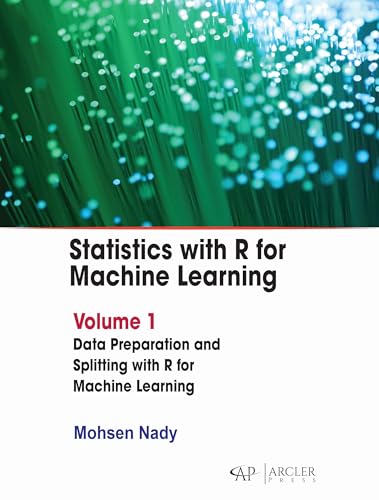
Statistics with R for Machine Learning, Volume 1
Master data preparation in R for machine learning with this concise guide to cleaning, transforming, and splitting datasets — essential for building accurate models.
Want to preview before you buy? Click Request Free Sample and tell us which chapter or pages you’d like to see, along with your email address. We’ll send you those pages from the eBook so you can be sure it’s the right one before buying.
- Instant download & lifetime access Available as soon as your payment is confirmed. Your download link is also sent to the email address you provide at checkout, and you can download your purchased eBook anytime from My Account → Downloads with unlimited downloads. An account is created automatically using the same email address.
- Own your eBook Receive the available PDF/EPUB file directly after purchase. No rental or temporary access — download and keep your eBook for personal use with lifetime access.
- Full refund guarantee If the eBook you receive does not match the details and description provided on the product page, contact [email protected] and we’ll issue a full refund within 24 hours.
- Secure payment through PayPal Pay securely by debit or credit card or with your PayPal account. Your card details are processed by PayPal and are never stored on our site.
$13.99$27.00
The Challenge It Addresses
Data preparation is the most time-consuming and error-prone phase of any machine learning project. Without clean, properly structured data, even the most sophisticated algorithms will fail to produce reliable results. Statistics with R for Machine Learning Volume 1 directly addresses this bottleneck by providing a focused, step-by-step framework for cleaning, transforming, and splitting datasets using the R programming language.
Many aspiring data scientists and analysts waste weeks wrestling with messy data, missing values, and inconsistent formats. This book eliminates that guesswork, offering a repeatable methodology that ensures your data is ready for modeling from the very first line of code.
About Statistics with R for Machine Learning Volume 1 by Mohsen Nady
Statistics with R for Machine Learning Volume 1 is a concise, technical guide that covers the foundational steps of building machine learning models in R. Published by Arcler Press in the 2025 e-book edition, it is organized into three targeted chapters that walk readers through data cleaning, transformation, and train-test splitting techniques.
Rather than attempting to cover every aspect of machine learning, this volume zeroes in on the critical pre-modeling stage — where most projects succeed or fail. It is the first installment in a series designed to build practical, incremental expertise in R for machine learning, making it an ideal starting point for both beginners and practitioners seeking to formalize their workflow.
Who Is This Book For?
This book is specifically designed for data analysts, aspiring data scientists, and R programmers who want to master the data preparation phase of machine learning. If you have basic familiarity with R syntax but need a structured approach to cleaning and splitting real-world datasets, this volume is for you.
It is also highly suitable for students in statistics, computer science, or data science programs who are working on their first machine learning projects and need a reliable reference for data preprocessing. Professionals transitioning from spreadsheet-based analysis to code-driven machine learning will find the step-by-step examples invaluable.
Key Takeaways
By working through this book, you will gain actionable skills in three core areas:
- Data Cleaning Techniques: Learn how to identify and handle missing values, remove duplicates, correct inconsistent data types, and manage outliers effectively in R.
- Data Transformation Methods: Master techniques such as normalization, scaling, encoding categorical variables, and creating feature-engineered variables using packages like
dplyrandtidyr. - Data Splitting Strategies: Understand how to properly partition your dataset into training, validation, and test sets using methods like random sampling, stratified splitting, and time-series-aware splits to avoid data leakage.
- Reproducible Workflows: Build scripts that can be reused across projects, ensuring consistency and saving hours of manual data manipulation.
- Handling Real-World Data: Work through examples that reflect the messy, incomplete data encountered in practice — not just clean textbook datasets.
- Integration with Machine Learning Pipelines: See how clean data feeds directly into model training, validation, and evaluation, with code snippets that bridge preparation and modeling.
- Best Practices for Data Quality: Develop a critical eye for data issues and learn proactive strategies to prevent data quality problems from derailing your analysis.
How It Compares
Most machine learning resources rush through data preparation in a single chapter or assume readers already have clean data. This book dedicates its entire focus to the preparation stage, providing depth that even comprehensive textbooks lack. Unlike generic R tutorials that cover data cleaning briefly, this volume offers a systematic, project-ready methodology.
Competing titles often emphasize theory over practice, leaving readers with abstract concepts but no executable code. Statistics with R for Machine Learning Volume 1 balances statistical reasoning with hands-on R code, making it immediately applicable. Its three-chapter structure is designed for easy reference — you can return to specific techniques without wading through hundreds of pages.
Furthermore, the book is published by Arcler Press, a respected academic and technical publisher, ensuring the content has undergone rigorous editorial review. The 2025 edition reflects the latest best practices in data science, including modern R packages and up-to-date splitting strategies.
About the Author
Author Mohsen Nady brings deep expertise in statistics and machine learning, with a focus on making complex topics accessible to practitioners. The book is published by Arcler Press, an academic publisher known for high-quality technical and scientific works. This combination of author expertise and institutional backing ensures the material is both accurate and pedagogically sound.
Arcler Press maintains rigorous peer-review standards, meaning every technique and explanation has been vetted by subject-matter experts. Readers can trust that the code examples work, the statistical reasoning is correct, and the advice reflects current industry practices.
Is It Worth It?
If you are serious about machine learning with R, this volume is a smart investment. It fills a critical gap in the market by providing a dedicated, practical guide to data preparation — a stage that consumes up to 80% of a data scientist’s time according to industry surveys. Mastering the skills in this book will save you hours on every project and dramatically improve the quality of your models.
For students, the clear structure and focused scope make it an excellent companion to more theoretical courses. For professionals, it serves as a reusable reference you can consult whenever you encounter a new data cleaning challenge. The 2025 edition ensures you are learning with modern tools and techniques, not outdated methods.
Start Reading Statistics with R for Machine Learning Volume 1 by Mohsen Nady Today
Stop letting data cleaning slow down your machine learning projects. With this concise, authoritative guide, you will gain the confidence and skills to prepare any dataset for modeling in R. Whether you are a student building your first model or a professional seeking to streamline your workflow, this book is the fastest path to production-ready data.
This 2025 e-book edition from Arcler Press is available now — add it to your cart and start building better machine learning pipelines today.
Related products

Natural Language Processing with Spark NLP: Build Scalable NLP Applications
$27.00Master Spark NLP to build scalable text processing pipelines. Learn from the definitive O’Reilly guide.
$59.00-
Big C++ 2nd Edition by Horstmann & Budd
$8.99Get the digital Big C++ 2nd Edition by Horstmann & Budd – the definitive guide to mastering C++ for students and professionals.
$15.00 -
The Definitive Guide to CentOS
$24.99The first definitive reference for CentOS, this guide provides hands-on network administration tutorials from members of the CentOS team.
$49.00 -
Mastering the Lightning Network: A Second Layer Blockchain Protocol for Instant Bitcoin Payments
$18.00Master the Lightning Network: the definitive guide to instant Bitcoin payments. Co-authored by LN creators, this O’Reilly book covers everything from payment channels to advanced routing.
$30.00 -
Practical Natural Language Processing: Build Real-World NLP Systems
$26.00Build, iterate, and deploy real-world NLP systems with this practical guide from O’Reilly — the definitive resource for production NLP.
$54.00 -
Generative Deep Learning, 2nd Edition: TensorFlow & Keras
$23.99Build cutting-edge generative AI models from scratch with TensorFlow and Keras in David Foster’s definitive Second Edition guide.
$49.00 -
Applied Natural Language Processing in the Enterprise
$26.99Master NLP with BERT and GPT-3 using Python in this hands-on guide for enterprise practitioners. Get your copy now.
$56.00 -
Practical Time Series Analysis: Prediction with Statistics and Machine Learning
$17.00Master time series analysis with statistics and machine learning using R and Python. Get Practical Time Series Analysis today.
$49.00