save
$32.01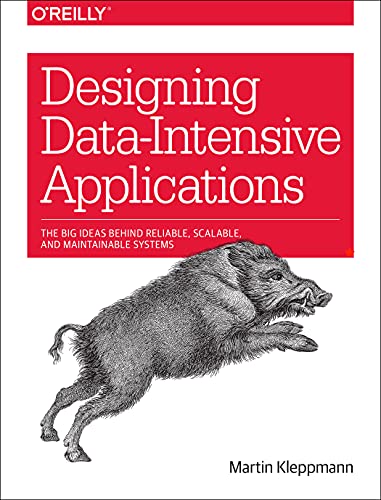
Designing Data-Intensive Applications: The Big Ideas Behind Reliable, Scalable, and Maintainable Systems
Master the foundational principles of reliable, scalable, and maintainable data systems with Martin Kleppmann’s definitive guide—get the knowledge that powers top tech architectures.
Want to preview before you buy? Click Request Free Sample and tell us which chapter or pages you’d like to see, along with your email address. We’ll send you those pages from the eBook so you can be sure it’s the right one before buying.
- Instant download & lifetime access Available as soon as your payment is confirmed. Your download link is also sent to the email address you provide at checkout, and you can download your purchased eBook anytime from My Account → Downloads with unlimited downloads. An account is created automatically using the same email address.
- Own your eBook Receive the available PDF/EPUB file directly after purchase. No rental or temporary access — download and keep your eBook for personal use with lifetime access.
- Full refund guarantee If the eBook you receive does not match the details and description provided on the product page, contact [email protected] and we’ll issue a full refund within 24 hours.
- Secure payment through PayPal Pay securely by debit or credit card or with your PayPal account. Your card details are processed by PayPal and are never stored on our site.
$26.99$59.00
The Problem This Book Solves
Modern applications are drowning in data. Developers and architects face the constant challenge of building systems that are reliable, scalable, and maintainable—often with conflicting trade-offs. Many books focus on specific databases or tools, but fail to provide the foundational understanding needed to navigate the ever-evolving data landscape. Without this knowledge, engineers struggle with system design decisions, leading to downtime, poor performance, and technical debt.
Designing Data-Intensive Applications directly addresses this crisis. Author Martin Kleppmann distills the core principles and practical patterns behind today’s most robust data systems, empowering you to make informed architectural choices.
Inside Designing Data-Intensive Applications: The Big Ideas Behind Reliable, Scalable, and Maintainable Systems: A Full Overview
Designing Data-Intensive Applications is the definitive guide to the fundamental ideas behind reliable, scalable, and maintainable data systems. Published by O’Reilly Media in its First Edition (2017), this book bridges the gap between theoretical concepts and real-world engineering decisions.
Instead of focusing on any single technology, Kleppmann explores the recurring themes and trade-offs that underpin databases, stream processors, batch processors, and more. From consistency models to replication strategies, from partitioning to transaction isolation levels, the book provides a comprehensive mental model for designing systems that perform under load and endure over time.
Who Is This Book For?
This book is essential reading for software engineers, software architects, and technical leaders who build or maintain data-intensive applications. If you work with distributed systems, databases, or large-scale data pipelines, Kleppmann’s insights will directly impact your day-to-day decisions.
It is equally valuable for senior developers transitioning into system design roles and computer science students seeking a practical grounding in distributed systems. Even experienced engineers will find new perspectives on the trade-offs between consistency, availability, and latency.
If you have ever faced a tough choice between SQL vs. NoSQL, synchronous vs. asynchronous replication, or strong vs. eventual consistency, this book gives you the vocabulary and framework to decide with confidence.
Key Takeaways
Designing Data-Intensive Applications delivers actionable knowledge across multiple dimensions of data system design:
- Reliability fundamentals — How to build systems that continue to work correctly even when failures occur, including hardware, software, and human errors.
- Scalability strategies — Techniques for maintaining good performance as load increases, from load parameters to coping with growth.
- Maintainability best practices — Designing systems that are easy to operate, evolve, and understand over their entire lifecycle.
- Data models and query languages — Comparisons of relational, document, graph, and other models, and how choice impacts application complexity.
- Storage and retrieval internals — Deep dives into B-trees, LSM-trees, and other storage engines that power modern databases.
- Encoding and evolution — How to manage schema changes and data format evolution in large-scale systems.
- Replication methods — Single-leader, multi-leader, and leaderless replication, along with the trade-offs in consistency and availability.
- Partitioning and secondary indexes — How to split data across nodes and support efficient queries in distributed environments.
- Transaction isolation levels — From read committed to serializable isolation, and the practical design choices each implies.
Why Choose This Edition
Unlike many books that simply catalog existing technologies, Designing Data-Intensive Applications teaches you the underlying principles that apply across all tools. Competing titles like “Database Internals” or “Distributed Systems for Practitioners” either skip the high-level architectural view or fail to connect theory to real-world engineering constraints.
Kleppmann’s unique approach combines academic rigor with hands-on examples. He explains the trade-offs behind each design decision—such as why eventual consistency might be acceptable in a social feed but not in a financial ledger—giving you the ability to reason about systems you’ve never encountered before.
The book also stands alone in its comprehensive coverage of both batch and stream processing, including Apache Kafka, Samza, and Spark. Most competing resources treat these as separate worlds; this book unifies them under a single mental model.
Author & Publisher Credentials
Martin Kleppmann is a respected researcher and engineer at the University of Cambridge, where his work focuses on distributed systems and data consistency. He brings both academic depth and substantial industry experience as a former engineer at LinkedIn and Rapportive. His ability to translate complex distributed systems theory into clear, practical advice is unmatched.
O’Reilly Media is the gold standard for technology books, known for its rigorous editorial process and commitment to timeless content. As a First Edition from 2017, this book has already proven its enduring relevance—its insights remain foundational for today’s data-intensive applications.
The Bottom Line
Without hesitation: yes. This book is widely regarded as one of the most important engineering reads of the past decade. It has consistently appeared on “must-read” lists for software engineers and is frequently referenced in system design interviews at top technology companies.
The book’s value lies in its durability. While specific database versions and frameworks change rapidly, the concepts of replication, partitioning, consistency, and scalability are timeless. By investing in this book, you are equipping yourself with knowledge that will serve you across multiple projects and roles over years to come.
Thousands of engineers have rated it as a career-defining resource. If you work with data at scale, this book will pay for itself many times over in the confidence and clarity it brings to your system design decisions.
Start Reading Designing Data-Intensive Applications: The Big Ideas Behind Reliable, Scalable, and Maintainable Systems Today
Stop guessing and start building reliable, scalable, and maintainable data systems. Whether you are preparing for a system design interview, architecting a new service, or debugging a production outage, Designing Data-Intensive Applications gives you the mental tools to succeed.
This First Edition from O’Reilly Media is available now. Add to cart and start reading on your Kindle, tablet, or computer within minutes. Secure your copy today and gain the deep understanding that separates great engineers from the rest.
Related products

Practical Data Science with SAP (First Edition)
$26.99Unlock machine learning techniques for enterprise data with Practical Data Science with SAP. Get your copy now.
$53.00-
Practical Deep Learning for Cloud, Mobile, and Edge
$25.99Build and deploy production-ready deep learning applications for cloud, mobile, browser, and edge devices with this hands-on O’Reilly guide.
$51.00 -
Object-Oriented Design Choices – Adair Dingle (1st Edition)
$28.99Master object-oriented design choices with this essential guide to composition, inheritance, and delegation trade-offs for better software design.
$65.00 -
Engineering High Quality Medical Software: Regulations, Standards, Methodologies & Tools for Certification
$51.99Master medical software certification with this essential guide covering regulations, standards, and methodologies. Get your copy today.
$129.00 -
Cassandra: The Definitive Guide, Revised Third Edition
$21.99Master Cassandra 4.0 with this revised third edition guide. Learn data modeling, architecture, and deployment for distributed NoSQL databases at scale.
$50.00 -
Data Science on AWS: End-to-End AI & ML Pipelines
$19.00Master end-to-end AI and ML pipelines on AWS with this practical guide by Chris Fregly and Antje Barth. Build and deploy data science projects in the cloud today.
$32.00 -
Deep Learning and the Game of Go: Build a Go-Playing AI
$25.99Master deep learning by building a Go-playing AI with this hands-on guide. Get the eBook now and start coding your own bot!
$51.00 -
Facilities Planning and Design – Pearson New International Edition
$21.00Master facility layout and material handling with this Pearson New International Edition. Get the complete analytical toolkit from Garcia-Diaz and Smith — order your ebook now.
$60.00