
save
$27.01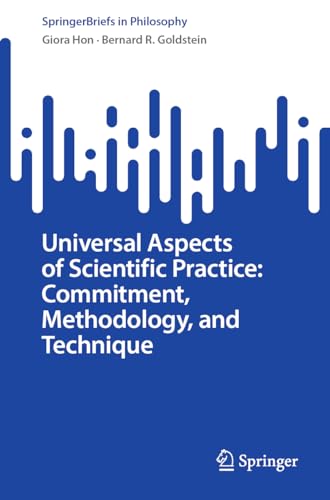
Universal Aspects of Scientific Practice: Commitment, Methodology, and Technique
Buy Universal Aspects of Scientific Practice: Commitment, Methodology, and Technique (Springer 2023) — a groundbreaking analysis of what scientists actually do, from two leading scholars.
Want to preview before you buy? Click Request Free Sample and tell us which chapter or pages you’d like to see, along with your email address. We’ll send you those pages from the eBook so you can be sure it’s the right one before buying.
- Instant download & lifetime access Available as soon as your payment is confirmed. Your download link is also sent to the email address you provide at checkout, and you can download your purchased eBook anytime from My Account → Downloads with unlimited downloads. An account is created automatically using the same email address.
- Own your eBook Receive the available PDF/EPUB file directly after purchase. No rental or temporary access — download and keep your eBook for personal use with lifetime access.
- Full refund guarantee If the eBook you receive does not match the details and description provided on the product page, contact [email protected] and we’ll issue a full refund within 24 hours.
- Secure payment through PayPal Pay securely by debit or credit card or with your PayPal account. Your card details are processed by PayPal and are never stored on our site.
$22.99$50.00
The Problem This Book Solves
Philosophy of science has long been dominated by abstract theory—debates over paradigms, demarcation, and the logic of justification. Yet working scientists know that the real engine of discovery lies in practice: the tacit commitments, the methodological choices, and the hands-on techniques that shape every experiment. Universal Aspects of Scientific Practice bridges this gap, offering a systematic framework for understanding what scientists actually do—not just what they say they do.
For researchers, educators, and advanced students, this book provides the conceptual tools to analyze scientific work as a coherent set of practices, moving beyond idealized models to capture the messy, iterative reality of laboratory and field research.
What Is Universal Aspects of Scientific Practice? A Complete Overview
Universal Aspects of Scientific Practice: Commitment, Methodology, and Technique is a 2023 scholarly monograph from Springer that reexamines the foundations of scientific inquiry through the lens of practice. Co-authored by Giora Hon and Bernard R. Goldstein—both distinguished historians and philosophers of science—the book argues that three universal dimensions underlie all scientific work: the commitments scientists bring to their investigations, the methodologies they adopt, and the techniques they deploy.
The authors draw on historical case studies and philosophical analysis to show how these dimensions interact, evolve, and sometimes conflict. Rather than presenting a single grand theory, the book offers a flexible analytic vocabulary that can be applied across disciplines—from physics to biology to the social sciences. This makes it an essential resource for anyone seeking a deeper understanding of how science actually progresses.
Who Should Read Universal Aspects of Scientific Practice?
This book is designed for an advanced audience with a serious interest in the philosophy, history, or sociology of science. It is particularly valuable for:
- Graduate students in philosophy of science looking for a fresh, practice-oriented alternative to standard textbook treatments
- Professional scientists who want to reflect critically on their own research practices and methodological assumptions
- Historians of science seeking a robust conceptual framework for analyzing past and present scientific work
- Science studies scholars working at the intersection of philosophy, history, and social studies of science
- Science educators designing curricula that emphasize the nature of scientific practice over rote content
If you have ever asked yourself “Why do scientists do things this way?” or “What makes one methodology more reliable than another?”, this book offers the analytical depth you need.
6 Key Things You Will Learn
Universal Aspects of Scientific Practice is organized around a clear, three-part framework. By reading it, you will gain:
- A new definition of scientific commitment—how prior beliefs, theoretical allegiances, and epistemic values shape research agendas and experimental design
- A taxonomy of methodological approaches—from inductive to abductive, from qualitative to quantitative, and how they interact in practice
- An analysis of technique as a distinct dimension—the craft knowledge, instrumental skills, and procedural routines that are often invisible in formal accounts of science
- Historical case studies that illustrate how commitment, methodology, and technique have co-evolved in fields ranging from astronomy to molecular biology
- A critical comparison with competing frameworks—including Kuhn’s paradigms, Lakatos’s research programmes, and Latour’s actor-network theory
- Practical implications for contemporary scientific practice, including how to identify and evaluate the commitments underlying current research programs
Each chapter builds on the last, culminating in a synthetic vision of science as a dynamic, practice-based enterprise.
Why Universal Aspects of Scientific Practice Outperforms Every Alternative
Most philosophy of science texts remain trapped in the theory-observation dichotomy, debating whether theories are confirmed or falsified by data. Universal Aspects of Scientific Practice breaks free from this tired framework by centering practice itself. Where other books offer abstract principles, Hon and Goldstein provide an empirically grounded, historically informed analysis that resonates with how scientists actually work.
Unlike Thomas Kuhn’s Structure of Scientific Revolutions, which focuses on paradigm shifts at the macro level, this book drills down to the micro level of daily scientific activity. Unlike Imre Lakatos’s Methodology of Scientific Research Programmes, it does not reduce practice to a set of rational rules. And unlike Bruno Latour’s Laboratory Life, it retains a normative dimension, asking not just what scientists do, but what they should do.
The result is a unique synthesis that is both descriptively rich and philosophically rigorous—a book that belongs on the shelf of every serious student of science.
Author Authority & Publisher Credibility
Giora Hon is Professor Emeritus of Philosophy at the University of Haifa, where he has spent decades researching the history and philosophy of scientific practice. His work has appeared in leading journals such as Studies in History and Philosophy of Science and Archive for History of Exact Sciences. Bernard R. Goldstein is Professor Emeritus of History and Philosophy of Science at the University of Pittsburgh, a Fellow of the American Association for the Advancement of Science, and a recipient of the prestigious George Sarton Medal for lifetime achievement in the history of science.
Together, they bring a combined century of scholarly experience to this project. The book is published by Springer, one of the world’s most respected academic publishers, known for its rigorous peer-review process and high editorial standards. This combination of author expertise and institutional backing ensures that every claim in the book is carefully researched and substantiated.
Is Universal Aspects of Scientific Practice Worth It? Our Verdict
This is not a light read, and it is not intended for casual browsing. Universal Aspects of Scientific Practice is a demanding work that rewards careful study. For its target audience—graduate students, professional scientists, and scholars in philosophy and history of science—it is an indispensable contribution that fills a genuine gap in the literature.
The book’s three-dimensional framework (commitment, methodology, technique) is both original and useful. The historical case studies are well-chosen and illuminating. And the authors’ willingness to engage critically with alternative approaches adds depth and nuance. If you are serious about understanding scientific practice, this is the book to read.
One caveat: the book assumes familiarity with basic concepts in philosophy of science. Beginners may want to start with a more introductory text before tackling this one. But for those with the necessary background, it is a highly rewarding investment.
Get Universal Aspects of Scientific Practice — Deepen Your Understanding of Scientific Practice Today
Whether you are a graduate student preparing for comprehensive exams, a researcher seeking to refine your methodological approach, or a scholar looking for fresh theoretical resources, Universal Aspects of Scientific Practice: Commitment, Methodology, and Technique offers the analytical tools you need. Published by Springer in 2023, this is the most current and comprehensive treatment of its subject available.
Add to cart now and gain a new perspective on the practice of science—one that will inform your thinking for years to come.
Related products

Big C++ 2nd Edition by Horstmann & Budd
$8.99Get the digital Big C++ 2nd Edition by Horstmann & Budd – the definitive guide to mastering C++ for students and professionals.
$15.00-
The Definitive Guide to CentOS
$24.99The first definitive reference for CentOS, this guide provides hands-on network administration tutorials from members of the CentOS team.
$49.00 -
Network Basics for Hackers: How Networks Work and How to Break Them
$8.00Master network exploitation with Occupytheweb’s practical guide to protocols, packet analysis, and attack techniques — your foundation for real-world hacking.
$13.00 -
AI 2041: Ten Visions for Our Future – First Edition eBook
$3.99AI 2041 combines ten gripping short stories with expert analysis to reveal how AI will reshape work, society, and daily life by 2041. Buy the first edition ebook now.
$11.00 -
Think Bayes: Bayesian Statistics in Python, 2nd Edition
$17.00Master Bayesian statistics with Python through practical examples and computational methods in Think Bayes, 2nd Edition. Get instant digital access now.
$34.00 -
Building Machine Learning Powered Applications – Hands-On ML Deployment Guide
$18.99Master the end-to-end process of building and deploying ML-powered applications with this practical O’Reilly guide by Emmanuel Ameisen.
$36.00 -
Head First Java (3rd Edition) – A Brain-Friendly Guide
$22.99Master Java with the engaging, brain-friendly 3rd edition of Head First Java. Perfect for beginners and intermediate learners — start coding today!
$45.00 -
Mastering the Lightning Network: A Second Layer Blockchain Protocol for Instant Bitcoin Payments
$18.00Master the Lightning Network: the definitive guide to instant Bitcoin payments. Co-authored by LN creators, this O’Reilly book covers everything from payment channels to advanced routing.
$30.00