save
$12.01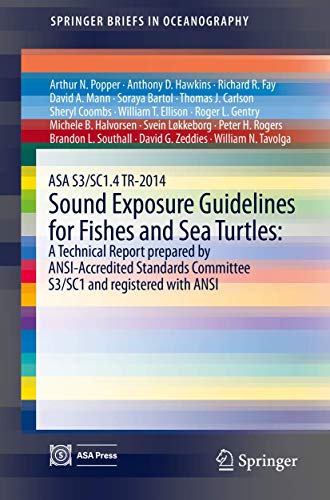
Sound Exposure Guidelines for Fishes and Sea Turtles
Get the official ANSI-registered technical report on sound exposure guidelines for fishes and sea turtles from Springer. Essential for marine biologists and regulators. Order your digital copy today.
Want to preview before you buy? Click Request Free Sample and tell us which chapter or pages you’d like to see, along with your email address. We’ll send you those pages from the eBook so you can be sure it’s the right one before buying.
- Instant download & lifetime access Available as soon as your payment is confirmed. Your download link is also sent to the email address you provide at checkout, and you can download your purchased eBook anytime from My Account → Downloads with unlimited downloads. An account is created automatically using the same email address.
- Own your eBook Receive the available PDF/EPUB file directly after purchase. No rental or temporary access — download and keep your eBook for personal use with lifetime access.
- Full refund guarantee If the eBook you receive does not match the details and description provided on the product page, contact [email protected] and we’ll issue a full refund within 24 hours.
- Secure payment through PayPal Pay securely by debit or credit card or with your PayPal account. Your card details are processed by PayPal and are never stored on our site.
$11.99$24.00
The Problem This Book Solves
Anthropogenic underwater noise from shipping, construction, sonar, and seismic surveys poses a growing threat to marine life. Yet for decades, regulators and researchers lacked standardized sound exposure guidelines for fishes and sea turtles. Without clear criteria, environmental impact assessments remained inconsistent, and protective measures were often guesswork. This technical report fills that critical gap.
Produced by an ANSI-accredited standards committee, the document delivers the first broadly applicable framework for evaluating how different sound sources affect these animals. It translates complex acoustic science into actionable exposure tables, enabling evidence-based decisions for marine conservation and permitting.
What Is Sound Exposure Guidelines for Fishes and Sea Turtles? A Complete Overview
Published by Springer in 2014, this Springer technical report is the outcome of a dedicated Working Group convened by the ANSI-Accredited Standards Committee S3/SC1. It establishes interim sound exposure guidelines for fish and sea turtles, organized by how each group detects sound—via particle motion, pressure, or both. The report defines appropriate acoustic metrics and presents the guidelines in a series of tables.
Where numerical values are available, they are expressed in those metrics. Where data are insufficient, the report rates the relative likelihood of effects, acknowledging that actual impact depends on received level. The guidelines are explicitly interim, with recommendations for priority research to refine and expand them.
Who Will Benefit Most
This reference is designed for professionals who need authoritative, actionable noise exposure criteria in marine environments. It is essential for:
- Marine biologists and fisheries scientists studying the effects of underwater noise
- Acoustic consultants conducting environmental impact assessments for offshore projects
- Regulatory agencies (e.g., NOAA, MMO) developing noise exposure thresholds
- Naval and defense researchers evaluating sonar impacts on marine fauna
- Renewable energy developers assessing pile-driving and construction noise
- Conservation NGOs advocating for science-based marine protection policies
- Graduate students and academics in marine bioacoustics, ichthyology, and herpetology
What You Will Learn
- How fish and sea turtles detect sound—particle motion vs. pressure detection and its implications for exposure metrics
- Specific sound exposure guidelines for different animal groups, presented in easy-to-reference tables
- Appropriate acoustic metrics for impulsive and continuous sound sources, including peak pressure and cumulative energy
- Relative likelihood of effects where numerical thresholds are not yet established, from no effect to mortality
- How the guidelines categorize sound sources—airguns, pile drivers, sonar, ships—and their typical characteristics
- The interim nature of the guidelines and the priority research needed to fill data gaps
- The ANSI-accredited standards process that ensures scientific rigor and broad stakeholder input
How It Compares
Unlike scattered journal articles or single-species studies, this report provides a consensus-based, multi-taxa framework vetted by a panel of leading experts. It directly addresses the challenge of diverse hearing modalities among fishes and sea turtles—a factor many earlier guidelines ignored. The tables allow immediate comparison across species groups and sound types, making it a practical tool for real-world assessments.
Competing resources often lack the ANSI accreditation and formal working group structure that gives this document regulatory weight. While some agencies have developed their own criteria (e.g., NOAA’s acoustic guidance for marine mammals), none cover fishes and sea turtles with the same taxonomic breadth and methodological transparency. This report also explicitly identifies knowledge gaps, guiding future research rather than pretending certainty.
Who Wrote This Book
The document is authored by Arthur N. Popper, Anthony D. Hawkins, Richard R. Fay, David A. Mann, Soraya Bartol, Thomas J. Carlson, Sheryl Coombs, William T. Ellison, Roger L. Gentry, Michele B. Halvorsen, Svein Løkkeborg, Peter H. Rogers, Brandon L. Southall, David G. Zeddies, and William N. Tavolga. Many are pioneers in fish bioacoustics and underwater noise. Popper, for example, is a professor emeritus at the University of Maryland and a leading authority on fish hearing.
Published by Springer, a premier scientific publisher, and registered with ANSI, the report carries the endorsement of the American National Standards Institute. The working group operated under the ANSI-Accredited Standards Committee S3/SC1, ensuring adherence to rigorous consensus processes. This pedigree makes the guidelines a trusted reference for regulatory and scientific use.
Is It Worth It?
For any professional involved in underwater noise management, this report is an indispensable reference. Its tables distill complex data into actionable numbers, while its candid discussion of uncertainty sets a standard for transparency. The interim nature is not a weakness—it acknowledges the current state of science and provides a clear roadmap for improvement.
Compared to the cost of conducting an original review or piecing together disparate sources, the price is a bargain. The combined expertise of the author team and the ANSI backing make this the most authoritative source available for sound exposure criteria for fishes and sea turtles. We highly recommend it for your professional library.
Download Sound Exposure Guidelines for Fishes and Sea Turtles Now
Whether you are assessing offshore wind farm impacts, preparing environmental documentation, or researching fish hearing, this technical report equips you with the latest consensus-based guidelines. It is the go-to resource for regulators, consultants, and scientists who need defensible exposure thresholds.
Order your digital copy today and join the professionals using the ANSI-accredited standard (ASA S3/SC1.4 TR-2014) to protect marine life. This is a limited-edition electronic publication from Springer, available only while current stocks of the ISBN last. Add to cart now and ensure you have the definitive guidelines at your fingertips.
Related products

Genome Sequencing Technology and Algorithms – Essential Bioinformatics Guide
$31.99Master genome sequencing algorithms with this essential guide. Covers assembly, alignment, and variant calling for bioinformatics professionals.
$81.00-
Genetics 101: From Chromosomes and the Double Helix to Cloning and DNA Tests
$4.00Master the science of heredity with Genetics 101—a clear, jargon-free guide from chromosomes to DNA tests, perfect for students and curious minds.
$8.00 -
Cereal Genomics: Methods and Protocols – Essential Lab Protocols for Plant Researchers
$29.99Master cereal genome analysis with Springer’s definitive protocols for DNA/RNA extraction, gene isolation, and transformation. Essential for plant researchers.
$91.00 -
The Student’s Guide to Cognitive Neuroscience 4th Edition
$15.00Master the neural basis of cognition with Jamie Ward’s bestselling, updated Fourth Edition. A clear, comprehensive guide to methods and theory. Get your copy today.
$25.00 -
Textbook of Pharmacognosy Third Edition Mohammed Ali
$23.00Master crude drugs, chemical constituents, therapeutic uses, Ayurvedic formulations, and phytochemical investigation with this Third Edition (2025) by Prof. Mohammed Ali from CBS Publishers. Get your copy now.
$40.00 -
Anatomy & Physiology 6th Edition Marieb Hoehn
$23.99Get the streamlined Sixth Edition of Marieb & Hoehn’s Anatomy & Physiology — the clear, focused pathway to mastering human structure and function for health science success.
$51.00 -
Understanding Nutrition 15th Edition Whitney Rolfes
$9.00Master nutrition science with Understanding Nutrition, 15th Edition — the evidence-based textbook by Whitney & Rolfes. Get your copy today.
$15.00 -
Biochemistry: Concepts and Connections (2nd Edition)
$8.00Master biochemistry fundamentals with the 2nd Edition of Biochemistry: Concepts and Connections. Visual, real-world approach. Get your copy today!
$13.00