save
$11.00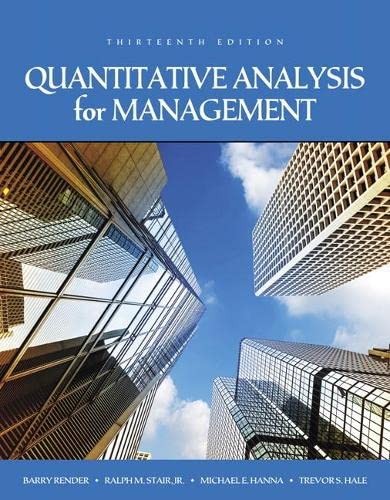
Quantitative Analysis for Management 13th Edition – Pearson
Master business analytics, quantitative methods, and management science with the 13th Edition of this essential Pearson textbook, featuring real-world examples and Excel integration.
Want to preview before you buy? Click Request Free Sample and tell us which chapter or pages you’d like to see, along with your email address. We’ll send you those pages from the eBook so you can be sure it’s the right one before buying.
- Instant download & lifetime access Available as soon as your payment is confirmed. Your download link is also sent to the email address you provide at checkout, and you can download your purchased eBook anytime from My Account → Downloads with unlimited downloads. An account is created automatically using the same email address.
- Own your eBook Receive the available PDF/EPUB file directly after purchase. No rental or temporary access — download and keep your eBook for personal use with lifetime access.
- Full refund guarantee If the eBook you receive does not match the details and description provided on the product page, contact [email protected] and we’ll issue a full refund within 24 hours.
- Secure payment through PayPal Pay securely by debit or credit card or with your PayPal account. Your card details are processed by PayPal and are never stored on our site.
$15.00$26.00
The Problem This Book Solves
Managers and analysts in today’s data-driven organizations face a persistent challenge: how to translate raw numbers into actionable business decisions. Without a solid grasp of quantitative methods and management science, even the most experienced professionals struggle to optimize operations, forecast demand, or allocate resources efficiently. This textbook bridges that gap, equipping students and practitioners with the analytical toolkit needed to make informed, evidence-based decisions under uncertainty.
Inside Quantitative Analysis for Management 13th Edition – Pearson: A Full Overview
Quantitative Analysis for Management, Thirteenth Edition, by Barry Render, Ralph M. Stair, Jr., Michael E. Hanna, and Trevor S. Hale, is a comprehensive textbook published by Pearson in 2018. It provides undergraduate and graduate students with a practical foundation in business analytics, quantitative methods, and management science. The book demystifies core techniques—from linear programming and regression analysis to simulation and decision theory—through real-world examples, step-by-step problem-solving, and extensive end-of-chapter exercises.
This edition reflects the latest developments in data-driven decision-making, integrating Excel and other software tools to prepare readers for the modern business environment. With over 500 pages of content, the text balances theoretical rigor with hands-on application, making it a staple in business school curricula worldwide.
Who Should Read This Book?
Quantitative Analysis for Management is designed for a broad audience, including undergraduate business majors, MBA students, and professionals seeking to strengthen their analytical skills. Specifically, it suits:
- Business students taking core courses in operations management, supply chain, or decision sciences
- Graduate students enrolled in MBA programs who need a practical understanding of quantitative models
- Working professionals in roles such as data analyst, operations manager, or consultant who require a refresher in management science
- Instructors looking for a clear, well-structured textbook with ample teaching resources
No prior expertise in advanced mathematics is assumed; the authors build concepts from the ground up, making the material accessible to learners at all levels.
Inside: What You Will Master
- How to formulate and solve linear programming problems for resource allocation
- Techniques for transportation, assignment, and network optimization
- Forecasting methods including moving averages, exponential smoothing, and trend projection
- Decision analysis under certainty, risk, and uncertainty
- Monte Carlo simulation and its applications in risk assessment
- Queueing theory for capacity planning and service design
- Inventory models for optimal stock management
- Regression and multiple regression for predictive modeling
- Project management techniques: PERT/CPM and critical path analysis
- Markov analysis for predicting future states
- Goal programming and multi-objective decision-making
Why Choose This Edition
Compared to competitors like Render/Stair’s own earlier editions or generic business statistics texts, the 13th Edition excels in its balance of theory and practice. Where rival textbooks often bury readers in abstract proofs, this volume emphasizes step-by-step worked examples and Excel-based solutions that mirror real-world workflows. The inclusion of model-building cases at the end of each chapter forces students to apply concepts in unstructured scenarios—a critical skill that many competing titles neglect.
Furthermore, the author team brings decades of combined teaching and consulting experience. Barry Render is a noted authority in management science, and the co-authors contribute expertise in operations, statistics, and analytics. This depth is evident in the book’s clear explanations and carefully curated problem sets, which range from basic drills to comprehensive mini-cases.
While some digital-only resources offer fragmented modules, this textbook provides a coherent, end-to-end curriculum that aligns with standard semester timelines. Instructors benefit from a full suite of ancillary materials, including test banks, PowerPoint slides, and instructor manuals—substantially reducing course preparation time.
Who Wrote This Book
The authors of Quantitative Analysis for Management are respected academics with extensive backgrounds in operations research and management science. Barry Render has authored over 100 articles and textbooks, and his work is widely adopted in business programs globally. Ralph M. Stair, Jr. is known for his contributions to information systems and quantitative methods. The team also includes Michael E. Hanna and Trevor S. Hale, both experienced educators and practitioners in the field.
Pearson, the publisher, is one of the world’s leading educational content providers, known for high-quality academic and professional resources. With over 150 years of publishing history, Pearson’s rigorous editorial process ensures that the content is accurate, up-to-date, and pedagogically sound. This institutional trust reinforces the textbook’s reliability as a learning tool.
The Bottom Line
For any student or professional serious about mastering quantitative methods and management science, this textbook is a sound investment. Its structured progression from fundamental concepts to advanced applications, combined with extensive practice opportunities, makes it a self-contained learning resource. The 13th Edition retains the classic strengths of earlier editions while incorporating contemporary examples and software integration, ensuring relevance in a rapidly evolving field.
Competing titles often lack the pedagogical coherence or supporting resources that Render et al. provide. While a library rental might suffice for a semester, owning your own copy—especially the digital edition—enables lifelong reference and review, particularly for professionals who need to revisit forecasting or optimization techniques years after graduation.
Get Your Copy Today
Whether you are an undergraduate business student, an MBA candidate, or a working professional, this book delivers the quantitative toolkit needed to succeed in analytics and operations roles. The 2018 Thirteenth Edition from Pearson ensures you are learning the most current methods and tools. Add to cart now and begin building the analytical confidence to tackle real-world business challenges.
Related products

Research Methods for Business 7th Edition | Sekaran & Bougie
$9.99Master business research with the 7th edition of Sekaran & Bougie’s practical, skill-building guide. Get the ebook now.
$18.00-
Budgeting 101: From Getting Out of Debt to Building Savings — Your Essential Guide
$7.00Master budgeting basics with this Simon & Schuster guide: get out of debt, track expenses, and build savings — start your financial transformation now.
$13.00 -
Paradox of Organizational Change: Engineering Organizations with Behavioral Systems Analysis
$15.99Master the systematic approach to sustainable change with Paradox of Organizational Change — the definitive guide to engineering organizations using behavioral systems analysis.
$29.00 -
Managing Business Ethics 7th Edition eBook — Treviño & Nelson
$15.99Master ethical decision-making with this practical, research-backed guide. Managing Business Ethics 7th Edition equips you to identify dilemmas and build stronger organizational culture.
$29.00 -
Personal Finance 101: Master Budgeting, Saving & Debt Management
$2.99Personal Finance 101: The all-in-one guide to budgeting, debt relief, saving, and retirement planning—simple, practical, and from Simon & Schuster. Take control of your money now.
$8.00 -
Essentials of Organizational Behavior 14th Edition – Robbins & Judge
$18.00Master workplace behavior with Essentials of Organizational Behavior 14th Edition — the concise yet comprehensive guide for students and professionals.
$41.00 -
Interviewing: Principles and Practices 16th Edition Stewart
$31.99Master every interview type with the 16th edition of Interviewing: Principles and Practices — the most widely-used interviewing textbook covering employment, performance, and counseling interviews with latest EEO and technology guidance.
$79.00 -
Business and Society: Stakeholders, Ethics, Public Policy 16th Edition
$4.00Order the 16th edition of Business and Society: Stakeholders, Ethics, Public Policy by Lawrence & Weber. Essential for business ethics courses. Download now.
$10.00