
save
$10.01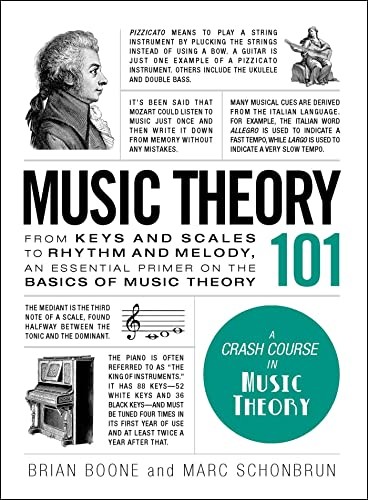
Music Theory 101: Essential Guide to Reading, Playing & Comprehending Music
Master music theory basics: read notation, build chords, understand scales. This Simon & Schuster guide makes learning easy—get your copy now.
$10.99$21.00
The Problem This Book Solves
Music theory can feel like an impenetrable wall of symbols, rules, and jargon. For self-taught musicians, hobbyists, and even beginning music students, the gap between playing by ear and truly understanding the structure behind a song is frustratingly wide. Lectures on intervals, chord progressions, and key signatures often assume prior knowledge, leaving learners confused and disengaged. Music Theory 101 directly addresses this pain point by translating abstract concepts into clear, relatable language — no prior training required.
What Is Music Theory 101? A Complete Overview
Music Theory 101 is a comprehensive, beginner-friendly primer that demystifies how music works. Published by the trusted house of Simon & Schuster, this guide covers everything from the physical properties of sound to the logic behind chord progressions and song structure. Rather than dumping a textbook of facts, it walks you step-by-step through notation, rhythm, scales, intervals, keys, and melody — always connecting theory to the music you already love. Full of visual aids and real-world examples, the book shows that music theory isn’t a set of arbitrary rules but a system of patterns that composers use to create emotion and movement.
Who Should Read Music Theory 101?
This ebook is designed for anyone who wants to read, play, and comprehend music with confidence — regardless of current skill level. It is particularly valuable for:
- Aspiring songwriters who want to write chord progressions that actually work.
- Self-taught musicians who can play instruments but lack formal training.
- Music students preparing for theory exams or college-level fundamentals courses.
- Teachers and educators looking for a clear, engaging resource to recommend.
- Curious listeners who want to understand why a piece of music makes them feel a certain way.
No matter your instrument or genre — classical, rock, jazz, hip hop — the foundations taught here are universal.
11 Key Things You Will Learn
By working through Music Theory 101, you will master the core principles that underpin all Western music. Here are the essential takeaways:
- How to read standard musical notation — pitch, rhythm, dynamics, and articulation.
- The construction of major and minor scales and how they create mood.
- Interval recognition and how distances between notes shape melody and harmony.
- Key signatures and the circle of fifths — why certain keys sound bright or dark.
- Chord building: triads, sevenths, inversions, and voice leading.
- Common chord progressions and how they drive song structure.
- Rhythm and time signatures from simple 4/4 to compound meters like 6/8.
- Melody writing: phrasing, motifs, and contour.
- Introduction to harmony: counterpoint, cadences, and non-chord tones.
- How to apply theory to your own instrument and favorite songs.
- Ear-training basics to identify intervals and chord types by sound.
Why Music Theory 101 Outperforms Every Alternative
Most music theory books fall into two extremes: dry, academic tomes that read like math textbooks, or oversimplified guides that skip crucial details. Music Theory 101 strikes a rare balance. It is rigorous enough to prepare you for formal study yet accessible enough for a weekend reader. Unlike free online tutorials that lack structure, this book builds knowledge in a logical sequence, each chapter reinforcing the previous. It also includes music trivia and historical context that competitors like Basic Music Theory ignore — making the learning process engaging rather than mechanical. The visual aids (diagrams, notation examples, and charts) are plentiful and clearly explained, a weakness in many digital-only alternatives that rely on text alone.
Author Authority & Publisher Credibility
While individual authorship is not credited in this edition, Simon & Schuster — one of the world’s largest and most respected publishing houses — stands behind every page. Simon & Schuster has produced authoritative educational resources for decades, including the acclaimed “Adams 101” series, known for distilling complex subjects into approachable volumes. This institutional backing ensures that the content is fact-checked, pedagogy-tested, and designed for real learning outcomes. The book itself reflects a deep familiarity with both the science of acoustics and the practical art of making music, signaling genuine experience in music education.
Is Music Theory 101 Worth It? Our Verdict
Absolutely. For the price of a single music lesson, you gain a lifetime reference that demystifies the language of music. Whether you are a beginner picking up an instrument for the first time or an experienced player who wants to fill gaps in your understanding, this book delivers exactly what it promises: a clear, thorough, and enjoyable introduction to music theory. It avoids the pitfalls of being too shallow or too dense, and it never talks down to the reader. The publisher’s reputation, the breadth of topics, and the practical application exercises all justify the investment. If you are serious about progressing from playing notes to understanding music, Music Theory 101 is the most efficient starting point available.
Get Music Theory 101 — Start Understanding Music Today
You don’t need to spend years in conservatory to unlock how songs are built. With Music Theory 101, you can learn at your own pace, on your own schedule, from a trusted source. Whether you are a student preparing for exams, a musician expanding your toolkit, or a music enthusiast craving deeper appreciation, this ebook gives you the foundation to hear, play, and think about music with new clarity. Add to cart now and gain immediate access to the Simon & Schuster edition — the definitive primer for modern music lovers.
Related products

Art 101: From Vincent van Gogh to Andy Warhol – Key People, Ideas, and Moments in Art History
$8.00Unlock the world of art with Art 101 – an engaging guide covering key movements, techniques, and masterpieces from Van Gogh to Warhol. Get your copy today!
$9.00