
save
$28.01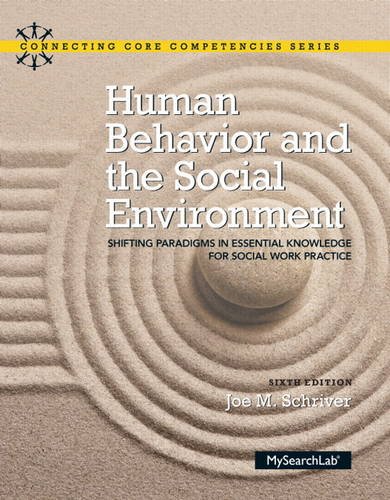
Human Behavior and the Social Environment: Shifting Paradigms in Essential Knowledge for Social Work Practice (6th Edition)
Master both traditional and alternative paradigms of human behavior with Schriver’s Sixth Edition — the essential HBSE text for CSWE-accredited social work programs.
$17.99$46.00
The Problem This Book Solves
Social work students and professionals face a persistent challenge: the traditional models of human behavior taught in foundational courses often fail to capture the complexity of clients’ lives, especially those from marginalized or diverse backgrounds. Relying on outdated, linear frameworks can lead to incomplete assessments and ineffective interventions. This book directly addresses that gap by equipping readers with a dual paradigm approach that integrates both traditional and alternative models of understanding human behavior.
By shifting the lens through which you view human development, Human Behavior and the Social Environment ensures you are prepared to meet the real-world demands of modern social work practice, where cultural competence and critical thinking are non-negotiable.
Human Behavior and the Social Environment: Shifting Paradigms in Essential Knowledge for Social Work Practice (6th Edition) at a Glance
Human Behavior and the Social Environment: Shifting Paradigms in Essential Knowledge for Social Work Practice is a comprehensive textbook authored by Joe M. Schriver and published by Pearson Education, Inc. in its Sixth Edition (2015). It is designed to serve as a core text for HBSE courses within CSWE-accredited social work programs. The book systematically explores both traditional (e.g., Erikson, Piaget) and alternative (e.g., feminist, multicultural, critical) theoretical frameworks for understanding human behavior across the lifespan.
Unlike many textbooks that present a single, dominant theoretical perspective, Schriver’s work deliberately juxtaposes multiple paradigms, encouraging students to critically evaluate each model’s applicability to diverse client populations. The text is organized around key social work competencies and ethical standards, making it a practical tool for both classroom learning and field placement application.
Who Will Benefit Most
This textbook is specifically designed for undergraduate and graduate social work students enrolled in HBSE courses. It is also an invaluable reference for:
- BSW and MSW students seeking a strong theoretical foundation for their practice.
- Social work educators looking for a text that challenges students to think critically about human development.
- Practicing social workers who want to update their knowledge of alternative paradigms to better serve diverse clients.
- Licensure exam candidates preparing for the ASWB exam, where HBSE content is a core domain.
- Allied human services professionals (counselors, psychologists, case managers) who require a nuanced understanding of person-in-environment frameworks.
If your work involves assessing, intervening, or advocating for individuals and communities, this book provides the conceptual tools to do so with depth and cultural humility.
Skills You Will Gain
By working through this Sixth Edition, you will develop mastery in the following essential areas:
- The person-in-environment perspective — a foundational framework for all social work assessment and intervention.
- Traditional lifespan theories — including psychodynamic, cognitive, and behavioral models, and their strengths and limitations.
- Alternative paradigm models — such as feminist, multicultural, social constructionist, and empowerment-based approaches.
- Critical analysis of theory — how to evaluate which framework best fits a given client’s context and identity.
- Integration of social work competencies — aligning theoretical knowledge with CSWE’s core practice behaviors.
- Application to diverse populations — understanding how race, class, gender, sexual orientation, and ability shape human development.
Each chapter includes case examples, discussion questions, and exercises that bridge theory and practice, ensuring you can immediately apply what you learn.
Why Choose This Edition
Most competing HBSE textbooks present a single theoretical model as the “right” way to understand human behavior. Schriver’s text is different. It deliberately introduces multiple, sometimes conflicting paradigms and equips students with the critical thinking skills to choose among them. This is not a passive reading experience; it is an active training in clinical judgment.
Furthermore, this Sixth Edition updates the content to reflect contemporary social issues, including expanded coverage of trauma-informed care, neurobiology, and the impact of technology on human relationships. Competitor texts often lag behind in integrating these modern concerns, making Schriver’s book a more current and relevant choice for today’s students.
Another key differentiator is the explicit connection to CSWE’s Educational Policy and Accreditation Standards (EPAS). Every chapter is mapped to specific core competencies, helping programs demonstrate accreditation alignment. No other HBSE text on the market offers this level of structured competency integration.
Who Wrote This Book
Joe M. Schriver is a respected scholar and educator in the field of social work. With decades of experience teaching HBSE courses, he brings both academic rigor and practical classroom wisdom to this text. His work is widely cited in social work education literature, and he has contributed significantly to the ongoing conversation about paradigm diversity in human behavior curricula.
Pearson Education, Inc. is one of the world’s leading educational publishers, known for producing high-quality academic textbooks that meet rigorous editorial and pedagogical standards. A Pearson textbook carries the weight of institutional trust and is vetted by expert reviewers from across the discipline. Choosing this edition means you are learning from a publisher that invests in accuracy, usability, and academic integrity.
Our Verdict
Yes. For any social work student or professional committed to culturally competent, critically reflective practice, this book is an essential investment. It does not simply teach you what theorists have said; it teaches you how to think like a social worker — weighing evidence, considering context, and choosing the most effective framework for each unique client situation.
The dual-paradigm structure is not just a pedagogical gimmick; it is a direct response to the complexity of real-world social work. Students who master this material will be better prepared for field placements, licensure exams, and ultimately, for making a meaningful difference in the lives of the people they serve. The Sixth Edition’s updated content ensures you are learning the most current perspectives available.
Download Human Behavior and the Social Environment: Shifting Paradigms in Essential Knowledge for Social Work Practice (6th Edition) Now
Whether you are a BSW student facing your first HBSE course or an MSW candidate deepening your theoretical toolkit, this Sixth Edition from Pearson is the most comprehensive and critically engaging resource available. Order your digital copy today and gain immediate access to the paradigms that will shape your entire social work career. Don’t settle for a textbook that teaches one way of seeing — invest in one that teaches you how to see the whole person in their environment.
Related products

Theories of Development: Concepts and Applications (6th Edition)
$12.99Get the 6th edition of Crain’s classic text covering 24 developmental theorists. Ideal for psychology students. Order your digital copy today!
$32.00-
America the Anxious: How Our Pursuit of Happiness Is Creating a Nation of Nervous Wrecks
$23.99British journalist Ruth Whippman’s sharp, funny investigation into America’s happiness industry—and why relentlessly chasing happiness can make us more anxious.
$53.00 -
Constitutional Law for a Changing America: Rights, Liberties, and Justice 10th Edition
$25.99Understand how political forces shape Supreme Court rulings on rights, liberties, and justice with this acclaimed 10th edition textbook by Epstein and Walker.
$60.00 -
General and Social Psychology by Robert H. Thouless – 2nd Edition
$19.99Secure your copy of the General and Social Psychology textbook by Robert H. Thouless, a classic for students of economics and social sciences.
$40.00 -
Ethical Dilemmas and Decisions in Criminal Justice, 10th Edition
$22.99Master ethical decision-making in criminal justice with this comprehensive guide to real-world dilemmas in policing, courts, and corrections.
$64.00 -
A History of Modern Psychology, 5th Edition – C. James Goodwin
$18.99Goodwin’s 5th edition offers a comprehensive, engaging history of modern psychology. Perfect for students and professionals—get your digital copy now!
$54.00 -
Becoming a Helper 8th Edition – Marianne & Gerald Corey eBook
$27.99Start your helping career with Corey & Corey’s Becoming a Helper, 8th Edition eBook—self-reflection, ethics, diversity, and practical skills in one essential guide.
$69.00 -
The Psychology of Emotion, 5th Edition – K.T. Strongman
$12.99Get the 5th edition of The Psychology of Emotion by K.T. Strongman — a comprehensive guide to emotion theories with everyday examples. Order your digital copy today.
$33.00