
save
$31.00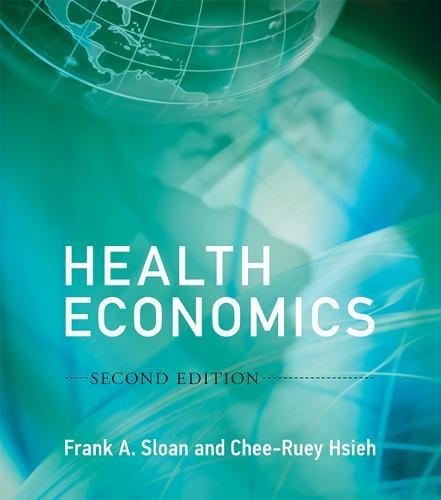
Health Economics, Second Edition by Sloan & Hsieh
Instant access to Health Economics, 2nd Edition — the MIT Press textbook that decodes healthcare markets and policy. Add to cart now.
$28.00$59.00
The Problem Health Economics Solves
Every healthcare system on earth faces the same hard constraint: unlimited demand for health against finite resources. Governments, insurers, hospitals, and patients must decide who gets what care, at what price, and with what quality — and those decisions are economic decisions before they are medical ones.
Yet most healthcare debates are conducted by people who understand either the medicine or the policy, but not the economics underneath it. The result is well-intentioned reform built on weak reasoning: unaffordable insurance mandates, mispriced pharmaceuticals, and regulatory interventions whose outcomes nobody modeled in advance.
Health Economics, Second Edition, by Frank A. Sloan and Chee-Ruey Hsieh, was written to close that gap. It equips students and professionals with the theoretical scaffolding and empirical tools to analyze health systems rigorously — not merely describe them.
About Health Economics, Second Edition by Sloan & Hsieh (eBook)
Health Economics is the discipline that applies economic theory and empirical methods to the production, distribution, and consumption of healthcare services, insurance, and public health programs.
Published by The MIT Press in 2017, this second edition builds on the strengths of the first by combining core economic concepts with empirical evidence drawn from real healthcare markets. The authors deliberately avoid the trap common to health textbooks: cataloguing health systems country by country without a theoretical lens. Instead, every institutional detail is anchored to an economic model you can actually use.
This edition is substantially updated with material on the Affordable Care Act and other major developments reshaping U.S. healthcare, making it a current text for classrooms and policy work alike.
The text moves progressively from microeconomic foundations to market structure and finally to evaluation methods, giving you a coherent pipeline from first principles to applied judgment. Core topics include the demand for health and healthcare, physician behavior, hospital competition, insurance markets, moral hazard, adverse selection, cost-effectiveness analysis, and the economics of health policy interventions.
Is This Book Right for You?
This is a graduate- and advanced undergraduate-level text, and it is equally valuable as a working reference for professionals who need economic fluency in healthcare. If you fit any of the profiles below, this book belongs on your digital shelf.
- Master’s and PhD students in health economics, public health, and health policy programs
- Economics undergraduates concentrating in applied microeconomics or public economics
- Policy analysts and government researchers evaluating healthcare programs and regulations
- Hospital administrators and finance officers who must justify capital and operating decisions
- Insurance and managed-care professionals working with premiums, utilization, and risk adjustment
- Clinicians and public health researchers who want to read economic evaluations with confidence
- Instructors seeking a rigorous, evidence-driven core text with strong theoretical foundations
Health Economics does not assume a prior economics degree, but it rewards readers who bring a serious interest in quantitative reasoning and public policy. Because the focus is on transferable economic reasoning rather than country-specific institutional detail, the book remains useful across international settings, not just the United States.
8 Key Things Health Economics Will Teach You
This book is organized around the questions that real policymakers and executives confront. By working through it, you will develop eight core competencies.
- How to model the demand for health and healthcare using established economic frameworks
- Why health insurance markets are prone to moral hazard and adverse selection — and which market designs mitigate them
- How the Affordable Care Act changed insurance coverage, provider incentives, and healthcare utilization in the United States
- How hospitals, physicians, and pharmaceutical firms respond to price signals, competition, and regulation
- How to conduct and interpret cost-effectiveness and cost-benefit analyses for medical interventions and public health programs
- How economic evidence shapes reimbursement, coverage decisions, and health technology assessment
- How different health systems finance care — from single-payer models to market-based insurance — and the trade-offs each involves
- How to critically evaluate empirical studies in health economics using the econometric techniques demonstrated in the text
Every chapter pairs theory with empirical evidence, so abstract concepts like demand elasticity and risk adjustment are never left floating without data. This progression matters because health economics is not a memorization subject — the value comes from taking an unfamiliar policy question, reducing it to its incentive structure, and reasoning toward an answer.
Why This Book Stands Out
Several textbooks compete in the health economics space, but most fall into two camps: descriptive surveys that summarize health systems without theoretical rigor, and theory-heavy monographs that leave readers unable to interpret real-world studies. Sloan and Hsieh occupy the productive middle — and that is what makes this book hard to beat.
What sets this edition apart:
- Empirical grounding. Every major concept is demonstrated with actual evidence from healthcare markets, not hypotheticals
- Policy relevance. Dedicated coverage of the Affordable Care Act ties the analysis to the issues dominating current American debate
- Balanced scope. Microeconomic foundations, market structure, and evaluation methods operate inside a single integrated framework
- Publisher rigor. The MIT Press is one of the most trusted scholarly publishers in the world, with editorial standards that general-trade publishers do not match
- Disciplined length. The book is comprehensive yet focused enough to serve as a one-semester core text
Alternative titles force buyers to choose between a health policy survey and an economics monograph. Health Economics integrates both streams into one coherent architecture — exactly what a serious course or professional library requires.
Author & Publisher Credentials
Health Economics was authored by Frank A. Sloan and Chee-Ruey Hsieh, two scholars whose research and teaching have helped shape the modern empirical health economics agenda. Their combined expertise spans health policy, insurance markets, regulation, and applied econometrics.
The book is published by The MIT Press, an imprint recognized worldwide for rigorous peer review, editorial independence, and scholarly precision. Carrying a MIT Press imprint signals institutional credibility to faculty, employers, and research partners.
This second edition, released in 2017 under ISBN 9780262035118, reflects the post-reform healthcare landscape rather than a pre-reform policy environment. For programs and libraries that require current edition integrity, this is the version to hold.
That depth of experience is visible on every page — the authors do not merely repeat received doctrine; they walk through the reasoning, show the evidence, and flag where theory and reality diverge.
Our Verdict
For any student of health policy, public health, or applied economics, the answer is unambiguous: yes. At a fraction of the $125.00 hardcover list price, the ebook delivers identical full content with searchability, portability, and instant delivery.
The second edition’s Affordable Care Act coverage alone justifies choosing it over the first edition. Healthcare policy moves quickly, and studying from outdated institutional material is a genuine liability — instructors and professionals need analytical frameworks applied to the current landscape.
Consider the comparison: many professionals assemble libraries of individual policy reports at $20–$40 each and still lack a unifying framework. One rigorous text gives you the lens to interpret all of them.
Where the book truly earns its keep is in professional practice. Analysts who evaluate programs, administrators who negotiate contracts, and researchers who design studies will return to the same toolkit again and again: incentives, elasticities, market failure, and welfare economics.
Add Health Economics, Second Edition by Sloan & Hsieh (eBook) to Your Library
You are one decision away from thinking about healthcare the way the best policy economists do. Whether you are a graduate student preparing for comprehensive exams, an analyst evaluating a reimbursement rule, or a public health professional who wants genuine economic credibility, this ebook delivers the framework you will use for your entire career.
Order now and receive instant access to the complete second edition. The 2017 edition is the current version — buying it today means you will not be studying outdated institutional content when the upcoming academic term begins.
Add Health Economics to your cart now. Published by The MIT Press, written by Sloan and Hsieh, and delivered digitally within minutes — secure your copy before the study-season rush.
Related products

Valuation: Measuring and Managing Company Value, 7th Ed.
$23.00Get the 7th edition of Valuation by McKinsey — the definitive guide to corporate valuation. Learn to measure and manage company value with proven frameworks.
$48.00-
Essentials of Health Policy and Law, 4th Edition – Public Health Textbook
$20.99Get the essential 4th edition of Health Policy and Law – a must-have textbook for public health students and professionals. Order now for instant digital access.
$47.00 -
Fiscal Administration 10th Edition – Analysis and Applications for the Public Sector
$22.00Master public sector finance with Fiscal Administration, 10th Edition. Get the definitive textbook by John Mikesell for budgeting, revenue, and debt management. Order now.
$37.00 -
Machine Learning and Data Science Blueprints for Finance
$16.00Build powerful trading strategies and robo-advisors with Python using this hands-on machine learning blueprint for finance professionals.
$26.00 -
Flash Boys: A Wall Street Revolt by Michael Lewis
$8.00Discover the true story of how Wall Street insiders rigged the stock market for high-frequency traders—and the unlikely heroes who fought back. Michael Lewis’s explosive exposé is a must-read for every investor.
$9.00 -
Day Trading for Beginners: Proven Strategies to Avoid the 90% Failure Rate
$12.00Master day trading with proven strategies that help you avoid the 90% failure rate. Get the blueprint to consistent profits—start today!
$20.00 -
Essentials of the U.S. Health Care System, 5th Edition
$36.99Get the essential 5th edition textbook on the U.S. health care system—concise, authoritative, and perfect for students and professionals. Buy now!
$65.00 -
Final Accounts Preparation Study Text: AAT Advanced Diploma in Accounting (2017-18)
$19.00Master final accounts for sole traders and partnerships with this Kaplan study text for the AAT Advanced Diploma. Get exam-focused content, practice questions, and trusted syllabus coverage.
$36.00