save
$6.00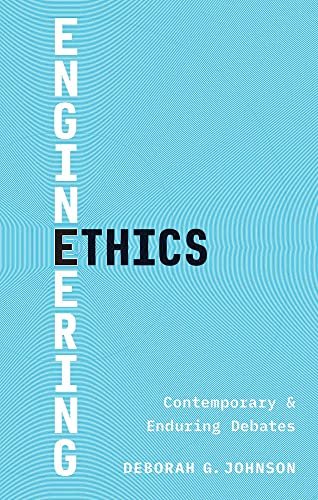
Engineering Ethics: Contemporary and Enduring Debates
Master ethical decision-making with Engineering Ethics: Contemporary and Enduring Debates by Deborah G. Johnson. Order today from Yale University Press.
Want to preview before you buy? Click Request Free Sample and tell us which chapter or pages you’d like to see, along with your email address. We’ll send you those pages from the eBook so you can be sure it’s the right one before buying.
- Instant download & lifetime access Available as soon as your payment is confirmed. Your download link is also sent to the email address you provide at checkout, and you can download your purchased eBook anytime from My Account → Downloads with unlimited downloads. An account is created automatically using the same email address.
- Own your eBook Receive the available PDF/EPUB file directly after purchase. No rental or temporary access — download and keep your eBook for personal use with lifetime access.
- Full refund guarantee If the eBook you receive does not match the details and description provided on the product page, contact [email protected] and we’ll issue a full refund within 24 hours.
- Secure payment through PayPal Pay securely by debit or credit card or with your PayPal account. Your card details are processed by PayPal and are never stored on our site.
$9.00$15.00
The Problem This Book Solves
Engineers routinely confront complex ethical dilemmas—from balancing safety against cost to deciding whether to blow the whistle on unsafe practices. Without a structured framework, these decisions can paralyze even seasoned professionals. This book provides exactly that framework, turning abstract moral philosophy into actionable reasoning.
Engineering Ethics: Contemporary and Enduring Debates tackles the most pressing moral questions in modern engineering practice. Rather than offering a single correct answer, it presents opposing viewpoints and invites readers to weigh evidence, consider stakeholders, and develop their own well-reasoned positions. This debate-centered approach mirrors the real-world negotiations engineers face daily.
From classic cases like the Challenger disaster to emerging issues in artificial intelligence and climate engineering, the book covers the full spectrum of ethical challenges that define the profession. It doesn’t shy away from controversy—it uses it as a teaching tool.
What Is Engineering Ethics: Contemporary and Enduring Debates?
Published in 2020 by Yale University Press, this 224-page volume is the first engineering ethics textbook to center each chapter around a structured debate. Author Deborah G. Johnson organizes the material around two types of debates: enduring debates that have shaped the profession for decades, and contemporary debates that reflect today’s technological and social changes.
The book opens with foundational questions about the nature of engineering as a profession and the meaning of professional responsibility. Subsequent chapters dive into risk assessment, the ethics of design, workplace loyalty and whistleblowing, sustainability, and the ethical implications of emerging technologies such as autonomous systems and big data analytics.
Each debate chapter presents arguments for and against a specific proposition, followed by analysis and discussion questions. This format not only teaches ethical theory but also hones critical thinking, argumentation, and communication skills—competencies that ABET and other accreditation bodies increasingly emphasize.
Who Should Read Engineering Ethics: Contemporary and Enduring Debates?
Engineering students at both undergraduate and graduate levels will find this an accessible yet rigorous introduction to professional ethics. Its debate structure makes it ideal for courses that require active participation and multiple perspectives.
Practicing engineers seeking to update their ethical reasoning toolkit will appreciate the real-world cases and the framework for making defensible decisions under pressure.
Ethics instructors can leverage the ready-made debates as classroom exercises, saving preparation time while fostering high-quality discussion.
Engineering managers and policymakers will benefit from the book’s analysis of systemic ethical issues, such as how organizational culture influences individual decision-making.
7 Key Things You Will Learn
- How to identify ethical issues embedded in engineering design, testing, and deployment phases
- The strengths and weaknesses of major ethical theories—utilitarianism, deontology, virtue ethics, and care ethics—when applied to engineering contexts
- How to analyze risk, uncertainty, and safety trade-offs using stakeholder analysis and ethical principles
- The ethical dimensions of whistleblowing: when loyalty to an employer conflicts with duty to the public
- How to balance environmental sustainability with technological progress and economic constraints
- The responsibilities of engineers in the age of AI, data privacy, and autonomous systems
- How to construct and defend a well-reasoned ethical argument in professional reports, meetings, and public hearings
Why Engineering Ethics Outperforms Every Alternative
Most engineering ethics textbooks follow a predictable pattern: a chapter on theory, followed by a set of case studies with suggested answers. Johnson’s book breaks this mold entirely. Every chapter is built around a genuine debate—with evidence and arguments for both sides presented fairly. Students are forced to think rather than memorize.
This approach aligns with the latest pedagogical research, which shows that debate-based learning increases engagement, retention, and transfer of skills to new situations. Additionally, the book’s concise length (224 pages) respects busy schedules while still covering the essential terrain. No other textbook offers this targeted combination of depth, breadth, and pedagogical innovation.
Author Authority & Publisher Credibility
Deborah G. Johnson is Professor Emerita of Engineering and Society at the University of Virginia, where she founded the program in Science, Technology, and Society. She is the author of several seminal works, including Computer Ethics and Ethics and Technology. Her decades of research and teaching give her unparalleled insight into what engineers need to know about ethics.
Yale University Press is one of the most respected academic publishers in the world, known for its rigorous editorial standards and commitment to high-quality scholarship. This partnership ensures that the content is both accurate and authoritative—a critical factor for textbooks used in formal education.
Is Engineering Ethics Worth It? Our Verdict
Absolutely. Whether you are a student required to study ethics for accreditation or a professional looking to strengthen your moral reasoning, this book delivers exceptional value. Its debate structure is not only pedagogically effective but also highly engaging, turning what could be a dry subject into a dynamic intellectual exercise.
The combination of Johnson’s expertise and Yale University Press’s reputation makes this the definitive choice for anyone serious about engineering ethics. No other textbook offers this unique blend of accessibility, depth, and debate-driven learning. For the price of a typical textbook, you get a resource that will serve you throughout your career.
Get Your Copy — Master Engineering Ethics Today
Don’t wait until you face an ethical crisis at work. Equip yourself now with the tools to navigate engineering’s toughest moral questions. This 2020 edition from Yale University Press is available immediately as an ebook—no shipping delays, instant access on any device.
Whether you are an engineering student building your professional foundation or a seasoned practitioner aiming to sharpen your ethical framework, this book is your essential guide. Add to cart now and start developing the ethical reasoning skills that set great engineers apart.
Related products

Deep Learning for Coders with fastai and PyTorch – Practical AI Guide
$22.99Master practical deep learning with fastai & PyTorch. No heavy math required. Get the authoritative guide by Jeremy Howard & Sylvain Gugger now.
$41.00-
Probability and Statistics for Engineering and the Sciences 8th Edition Devore
$17.00Master probability and statistics for engineering with Devore’s Eighth Edition—real-world examples, software integration, and clear explanations to boost your analytical skills.
$31.00 -
Fluid Dynamics of Particles, Drops, and Bubbles by Eric Loth
$35.99Master multiphase flow with Eric Loth’s 2023 Cambridge textbook covering theory, simulations, and experiments for particles, drops, and bubbles.
$104.00 -
Cassandra: The Definitive Guide, Revised Third Edition
$21.99Master Cassandra 4.0 with this revised third edition guide. Learn data modeling, architecture, and deployment for distributed NoSQL databases at scale.
$50.00 -
Practical Deep Learning for Cloud, Mobile, and Edge
$25.99Build and deploy production-ready deep learning applications for cloud, mobile, browser, and edge devices with this hands-on O’Reilly guide.
$51.00 -
Object-Oriented Design Choices – Adair Dingle (1st Edition)
$28.99Master object-oriented design choices with this essential guide to composition, inheritance, and delegation trade-offs for better software design.
$65.00 -
Docker Deep Dive: Zero to Docker in a Single Book (2023 Edition) by Nigel Poulton
$23.99Master Docker from scratch with the 2023 Edition of Docker Deep Dive by Nigel Poulton. Learn containers, networking, security, Wasm, and AI integration in one complete book.
$40.00 -
Fundamentals of Applied Electromagnetics 7th Edition – Ulaby & Ravaioli
$30.99Master electromagnetics with Ulaby & Ravaioli’s 7th edition — application-driven theory, Technology Briefs, and intuitive visuals for EE students and engineers.
$55.00