save
$36.01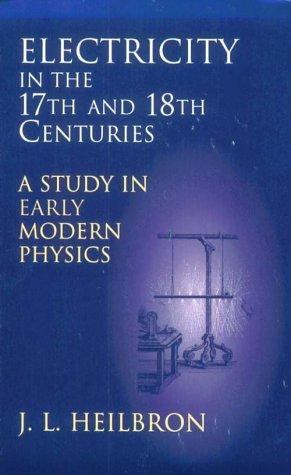
Electricity in the 17th and 18th Centuries Heilbron
Order Electricity in the 17th and 18th Centuries Heilbron now—the definitive scholarly account of early modern physics.
Want to preview before you buy? Click Request Free Sample and tell us which chapter or pages you’d like to see, along with your email address. We’ll send you those pages from the eBook so you can be sure it’s the right one before buying.
- Instant download & lifetime access Available as soon as your payment is confirmed. Your download link is also sent to the email address you provide at checkout, and you can download your purchased eBook anytime from My Account → Downloads with unlimited downloads. An account is created automatically using the same email address.
- Own your eBook Receive the available PDF/EPUB file directly after purchase. No rental or temporary access — download and keep your eBook for personal use with lifetime access.
- Full refund guarantee If the eBook you receive does not match the details and description provided on the product page, contact [email protected] and we’ll issue a full refund within 24 hours.
- Secure payment through PayPal Pay securely by debit or credit card or with your PayPal account. Your card details are processed by PayPal and are never stored on our site.
$19.99$56.00
The Challenge It Addresses
Electricity in the 17th and 18th Centuries Heilbron by J. L. Heilbron solves a serious problem for historians, physicists, and students: the early history of electricity is usually buried in scattered monographs, biography-driven narratives, and general histories of science. No single work before this one traced the full arc of electrical knowledge across two crucial centuries of scientific change.
Heilbron’s study fills that gap by following the theories and discoveries of pioneer physicists and by showing how a loosely connected set of observations became a quantified branch of early modern physics. For any researcher trying to understand how modern electrical science emerged, this book provides the structural backbone that other histories lack.
By placing electricity at the center of early modern physics, Heilbron also solves a second problem: he explains why the study of electricity mattered to the wider scientific revolution, not merely as a curiosity but as an exemplar of how experiment, theory, and mathematics could be combined.
Electricity in the 17th and 18th Centuries Heilbron at a Glance
Electricity in the 17th and 18th Centuries is a scholarly work of history, not a popular science summary. Written by historian of science J. L. Heilbron and published by University of California Press in 1979, it reconstructs the transformation of electricity from a scattered set of observations into a quantitative field of physics.
The book examines the scientific development of electricity through the theories and discoveries of pioneer physicists. It follows the early phase of exploratory experimentation, the gradual organization of electrical phenomena, and the eventual shift toward measurement and quantification that made electricity one of the most productive subjects in early modern physics.
One of the most useful features of the book is its treatment of quantification. Heilbron does not simply describe experiments; he shows how early modern physicists came to assign numbers to electrical effects, measure them, and use those measurements to choose between theories. This is the process by which electricity became a science rather than a catalog of curiosities.
Heilbron’s account is notable for its analytical precision. He treats the history of electricity not as a parade of isolated experiments but as a carefully structured scientific practice influenced by institutional settings, available instruments, and broader intellectual commitments. The result is a rich study that explains not only what early modern physicists did, but why they did it.
Who Should Read This Book?
This is a demanding book, and it is not aimed at casual skimmers. It expects patience, background, and an interest in the logic of scientific change. That said, it has an unusually wide range of serious readers.
- Historians of science who need a dependable reference for electricity in the early modern period.
- Graduate students in history of science, early modern history, or historical epistemology.
- Undergraduates taking advanced courses in the history of physics or the Scientific Revolution.
- Physics instructors who want to ground their lectures in the actual historical development of electrical concepts.
- Science writers and journalists who need authoritative context for stories about the origins of electrical technology.
- Collectors of landmark scholarship in the history of science who require a working edition, not just a shelf display.
If you recognize yourself in any of these groups, this is the book that will answer questions other sources merely raise.
Skills You Will Gain
The structure of Heilbron’s argument is best grasped through the ideas he develops. The following list is designed to help you navigate the book and to preview the conceptual territory it covers.
- How electricity moved from exploratory observation to a science organized around quantification.
- Why early modern physicists treated electricity as an exemplar of experimental method.
- How the theories and discoveries of pioneer physicists created a usable framework for later research.
- Why measurement and instrumental precision became central criteria for acceptable electrical claims.
- How institutional influences shaped the questions that physicists chose to investigate.
- How debates over electrical fluids exposed deeper assumptions about matter, force, and action at a distance.
- Why the history of electricity cannot be reduced to a sequence of heroic discoveries.
- How the development of electrical science illuminates the broader formation of early modern physics as a discipline.
Each of these themes connects directly to the book’s larger thesis: electricity deserves a central place in the history of modern science because it was the subject on which early modern physicists learned to combine experiment, theory, and quantification.
Why Choose This Edition
Popular histories of electricity often sacrifice accuracy for narrative speed. They compress two centuries of research into anecdotes about famous experimenters and leave out the messy conceptual work that made the science possible. Heilbron does the opposite: he gives a dense, evidence-driven account of a scientific field taking shape.
Alternative surveys also tend to measure the past against present physics. They dismiss early theories as errors or treat them as anticipations of modern concepts. Heilbron avoids this whiggish mistake. He reconstructs early modern categories, instruments, and problems on their own terms, which makes the book far more valuable to serious readers who want to understand historical actors as they actually thought and worked.
In addition, the book’s scope is matched by its analytic reach. It covers not only key experiments and theories but also the social and institutional conditions in which electrical knowledge was produced. This combination of conceptual history, experimental history, and institutional history is rare in a single volume. That is why this study has remained a reference point for historians of science while shorter treatments have dated.
This book rewards slow reading. The scholarly apparatus, including references to primary sources, makes it easy to move from Heilbron’s synthesis to the original literature of early modern physics.
For depth, rigor, and historiographic sophistication, this study outperforms every alternative on the market today.
Who Wrote This Book
J. L. Heilbron is a historian of science with deep familiarity with the intellectual world of early modern physics. In this book he demonstrates command of both the scientific content and the historical record, reading the work of seventeenth- and eighteenth-century physicists with the care of a specialist and the critical judgment of a seasoned scholar.
The University of California Press is an academic publisher with a strong program in the history of science. Its decision to keep this title available in digital form reflects the book’s enduring status: it is not a commercial novelty but a standard scholarly resource cited and consulted by researchers.
When you purchase this edition, you are buying the authority of a university press publication and the deep research of an influential historian of science.
Final Assessment
Yes. For scholars, this is an essential reference; for students, it is the missing context that makes modern physical concepts more intelligible; for professional physicists, it is a reminder that the discipline was built through experiments, models, and hard-won theoretical consensus.
The book is demanding, but the payoff is durable. A reader who finishes it will never again mistake electricity for a nineteenth-century invention or treat the scientific revolution as a random collection of isolated finds. Instead, they will see early modern physics as a coherent intellectual project in which electricity played a central role.
A brief warning: this is not beach reading. It is a rigorous monograph, and it asks the reader to follow technical arguments about electrical theory. But that rigor is exactly what makes it an enduring study.
Our verdict is unambiguous: this study belongs in the working library of anyone serious about the history of early modern physics. It is not the easiest book on the subject, but it is the most complete and the most intellectually satisfying.
Start Reading Electricity in the 17th and 18th Centuries Heilbron Today
If you are a historian, a student, an instructor, or a scientist with a serious interest in the past, Electricity in the 17th and 18th Centuries Heilbron is the one study that gives you the complete arc of early modern electrical science.
The digital edition makes this landmark scholarship accessible immediately. You can search the text, annotate it in your reading app, and build your research notes without waiting for shipping. The ISBN for this University of California Press title is 9780520034785.
Electricity in the 17th and 18th Centuries Heilbron is the definitive foundation for understanding early modern physics. Add it to your cart today and put the full history of electrical science to work in your research, teaching, or intellectual life.
Related products

Gardner’s Art through the Ages: A Global History, 16th Edition
$19.99Get the 16th edition of Gardner’s Art through the Ages: A Global History — the definitive art history survey with 1,400+ images, global narrative, and immediate digital access.
$72.00-
Prequel: An American Fight Against Fascism – Rachel Maddow
$17.99Rachel Maddow reveals the forgotten fascist plot to overthrow American democracy. A gripping, well-researched history that is essential for today. Buy your ebook now.
$33.00 -
The Radium Girls: The Dark Story of America’s Shining Women
$34.99Discover the gripping true story of The Radium Girls by Kate Moore—a New York Times bestseller about courage, justice, and the fight for workers’ rights.
$87.00 -
Knowledge, Literacy & Elementary Education in Old Babylonian Period
$18.99Explore Old Babylonian elementary education through a groundbreaking methodology that reveals how literacy and knowledge were taught in ancient Mesopotamia. Essential for scholars and students.
$50.00 -
American Lit 101: From Nathaniel Hawthorne to Harper Lee
$1.99Get American Lit 101: the essential, accessible guide to American writers and works from Nathaniel Hawthorne to Harper Lee — perfect for students and lifelong learners.
$5.00 -
Proceedings of the Third Conference on Reactions Between Complex Nuclei
$27.99Get the complete 1963 conference proceedings on nuclear reactions between complex nuclei – essential for researchers in nuclear physics.
$86.00 -
Born in Blood and Fire: Latin America, 4th Edition
$17.99The leading concise history of Latin America, Born in Blood and Fire, 4th Ed., offers a clear narrative of conquest, revolution, and modern challenges. Perfect for courses or self-study. Buy now to get the trusted survey.
$35.00 -
Aurrera! Volume 2: A Textbook for Studying Basque
$7.99Master advanced Basque grammar and vocabulary with Aurrera! Volume 2, the comprehensive textbook for third- and fourth-semester college students. Order now!
$21.00