save
$30.01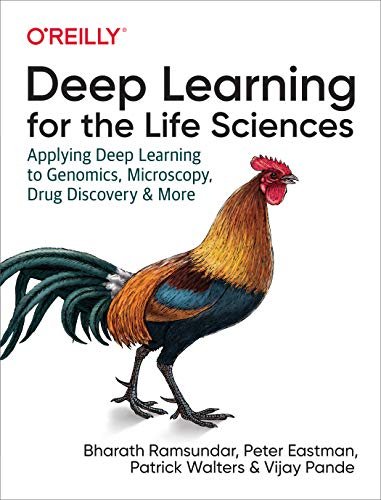
Deep Learning for the Life Sciences: Apply DL to Genomics & Drug Discovery
Learn to apply deep learning to genomics, microscopy, drug discovery, and more with this practical O’Reilly guide. Get your copy now.
Want to preview before you buy? Click Request Free Sample and tell us which chapter or pages you’d like to see, along with your email address. We’ll send you those pages from the eBook so you can be sure it’s the right one before buying.
- Instant download & lifetime access Available as soon as your payment is confirmed. Your download link is also sent to the email address you provide at checkout, and you can download your purchased eBook anytime from My Account → Downloads with unlimited downloads. An account is created automatically using the same email address.
- Own your eBook Receive the available PDF/EPUB file directly after purchase. No rental or temporary access — download and keep your eBook for personal use with lifetime access.
- Full refund guarantee If the eBook you receive does not match the details and description provided on the product page, contact [email protected] and we’ll issue a full refund within 24 hours.
- Secure payment through PayPal Pay securely by debit or credit card or with your PayPal account. Your card details are processed by PayPal and are never stored on our site.
$36.99$67.00
The Problem This Book Solves
Life sciences research generates vast datasets—from genome sequences to high-content microscopy images—that defy traditional analysis methods. Deep learning for the life sciences bridges this gap by equipping biologists, bioinformaticians, and computational scientists with the tools to extract meaningful patterns from complex biological data. This book teaches you how to apply deep learning directly to your research, whether you’re predicting drug-target interactions, classifying cell morphologies, or uncovering regulatory elements in DNA.
What Is Deep Learning for the Life Sciences? A Complete Overview
Deep Learning for the Life Sciences (First Edition, O’Reilly Media, 2019) is a practical guide that shows how to implement deep learning models for genomics, microscopy, drug discovery, and more. Written by Bharath Ramsundar, Peter Eastman, Patrick Walters, and Vijay Pande, this book is designed for researchers and practitioners who already have some familiarity with machine learning and want to apply deep learning to biological problems. It covers both the theoretical foundations and hands-on implementation using popular frameworks like TensorFlow and PyTorch, with code examples that you can adapt to your own data.
The book is not just a collection of algorithms—it provides a structured approach to solving real-world life sciences challenges, from preprocessing biological sequences to training models on limited biomedical datasets. With O’Reilly’s reputation for high-quality technical content, this is a trusted resource for anyone serious about integrating deep learning into their life sciences workflow.
Who Should Read Deep Learning for the Life Sciences?
This book is written for life scientists, bioinformaticians, and data scientists who want to leverage deep learning in their work. It is ideal if you:
- Are a researcher in genomics, proteomics, or drug discovery looking to adopt state-of-the-art deep learning methods
- Have basic machine learning knowledge but need a practical, application-focused guide for biology
- Work with high-dimensional biological data (sequence, image, graph) and want to build predictive models
- Want to understand how deep learning is transforming drug discovery and personalized medicine
- Need reproducible code and case studies to accelerate your own projects
If you fall into any of these categories, this book will save you months of trial and error.
7 Key Things You Will Learn
- How to apply deep learning to genomics—predicting regulatory elements, variant effects, and gene expression
- Techniques for microscopy image analysis including classification, segmentation, and feature extraction
- Deep learning for drug discovery: molecular property prediction, virtual screening, and de novo drug design
- How to work with graph neural networks for molecular structures and biological networks
- Strategies for training models on small biomedical datasets using transfer learning and data augmentation
- Hands-on implementation with TensorFlow and PyTorch with ready-to-run code examples
- Real-world case studies from the authors’ experience in top research labs and industry
Why Deep Learning for the Life Sciences Outperforms Every Alternative
Most deep learning books focus on general computer vision or NLP, leaving life scientists to bridge the gap themselves. This book instead centers on biological applications from the start. Unlike competing titles that are either too theoretical or too generic, Deep Learning for the Life Sciences gives you both the intuition and the code to solve problems like predicting drug-target affinity or classifying cell types from images. It is the only book co-authored by the creator of the DeepChem open-source library (Bharath Ramsundar), so the examples are battle-tested in real research environments. The O’Reilly edition ensures professional editing and accuracy—you won’t find the same depth in free online tutorials or blog posts.
Additionally, the book covers graph neural networks and molecular representations—cutting-edge topics that are still missing from many other machine learning textbooks for biology. This makes it the definitive guide for anyone serious about deep learning in the life sciences.
Author Authority & Publisher Credibility
The authors of this book are recognized experts at the intersection of deep learning and life sciences. Bharath Ramsundar created DeepChem, the most popular open-source library for deep learning in drug discovery. Peter Eastman has a background in computational chemistry and contributed to major molecular simulation projects. Patrick Walters brings industry experience in pharmaceutical data science, and Vijay Pande is a pioneer in applying machine learning to biomedicine. Their collective expertise ensures that every technique in the book is both theoretically sound and practically proven. O’Reilly Media, the publisher, is synonymous with high-quality technical education worldwide—their books are used by professionals at leading companies and research institutions.
Is Deep Learning for the Life Sciences Worth It? Our Verdict
Absolutely. If you are a life scientist or data scientist who wants to apply deep learning to real biological datasets, this book is one of the best investments you can make. It delivers what it promises: a clear, actionable guide to genomics, microscopy, drug discovery, and more—with code that works. The first edition (2019) remains current and contains foundational knowledge that does not go out of date quickly. Compared to piecing together information from scattered blog posts and papers, this book will save you time and give you a coherent framework. For students, researchers, and industry practitioners alike, it earns a strong recommendation.
Get Deep Learning for the Life Sciences — Your Essential Guide to DL-Driven Research
Whether you’re a student entering bioinformatics, a researcher looking to add deep learning to your toolkit, or a professional in drug discovery, this book is your shortcut to proficiency. The O’Reilly First Edition is the definitive resource for applying deep learning to genomics, microscopy, and drug discovery—order it today and start building models that make a difference in life sciences research.
Related products

Discovering Human Sexuality 4th Edition – Simon LeVay
$12.99The most accessible, evidence-based introduction to human sexuality, now in a fully updated fourth edition from Oxford University Press.
$23.00-
Campbell Biology 12th Edition eBook by Urry
$34.99Master biology with Campbell Biology 12th Edition eBook by Urry. Get the definitive Pearson text for majors, pre-med, and AP Biology instantly.
$91.00 -
Understanding Nutrition 15th Edition Whitney Rolfes
$36.99Master nutrition science with Understanding Nutrition, 15th Edition — the evidence-based textbook by Whitney & Rolfes. Get your copy today.
$102.00 -
Concepts of Genetics Klug (12th Edition)
$32.00Master genetics with this best-selling textbook that emphasizes fundamental ideas and modern techniques. Get your digital copy today and start solving genetic problems effectively.
$87.00 -
Textbook of General Virology, 1st Edition
$29.99Textbook of General Virology Kumar eBook: 2025 first edition — virus structure, emerging viruses, vaccines, and more. Get instant access today.
$69.00 -
Cereal Genomics: Methods and Protocols – Essential Lab Protocols for Plant Researchers
$29.99Master cereal genome analysis with Springer’s definitive protocols for DNA/RNA extraction, gene isolation, and transformation. Essential for plant researchers.
$91.00 -
Molecular Biology of the Cell 6th Edition – Alberts et al. Garland Science
$7.99Master cell biology with the definitive 6th edition by Alberts et al. — the gold standard textbook for students and researchers. Order your copy today.
$15.00 -
Basic Laboratory Methods for Biotechnology: Textbook and Laboratory Reference, 2nd Edition
$8.00Master essential biotechnology lab techniques with this comprehensive textbook and reference. Covers molecular biology, quality systems, safety, and more. Get your copy now.
$24.00