save
$25.01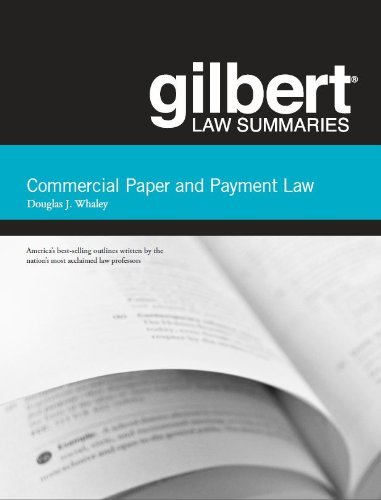
Commercial Paper & Payment Law (Gilbert Law Summaries, 17th Ed.) eBook
Master commercial paper and payment law with the trusted Gilbert Law Summaries outline — authored by Douglas Whaley, 17th edition, instantly accessible as an eBook.
Want to preview before you buy? Click Request Free Sample and tell us which chapter or pages you’d like to see, along with your email address. We’ll send you those pages from the eBook so you can be sure it’s the right one before buying.
- Instant download & lifetime access Available as soon as your payment is confirmed. Your download link is also sent to the email address you provide at checkout, and you can download your purchased eBook anytime from My Account → Downloads with unlimited downloads. An account is created automatically using the same email address.
- Own your eBook Receive the available PDF/EPUB file directly after purchase. No rental or temporary access — download and keep your eBook for personal use with lifetime access.
- Full refund guarantee If the eBook you receive does not match the details and description provided on the product page, contact [email protected] and we’ll issue a full refund within 24 hours.
- Secure payment through PayPal Pay securely by debit or credit card or with your PayPal account. Your card details are processed by PayPal and are never stored on our site.
$16.99$42.00
The Problem This Book Solves
Commercial Paper & Payment Law — the law of negotiable instruments, bank deposits, and electronic payments — is a dense, detail-rich subject that trips up even the most diligent law students. The sheer volume of UCC Articles 3, 4, and 4A, combined with evolving federal regulations, creates a steep learning curve. Without a clear, structured guide, students waste hours untangling doctrines like holder in due course, negotiability, and final payment. This Gilbert Law Summary, in its Seventeenth Edition, exists for exactly that reason: to distill complex payment law into a comprehensible, exam-ready format that lets you master the material in less time.
What Is Commercial Paper & Payment Law? A Complete Overview
Commercial Paper & Payment Law is a comprehensive law school study aid from the renowned Gilbert Law Summaries series. This Seventeenth Edition, authored by Professor Douglas J. Whaley of The Ohio State University Moritz College of Law — a nationally recognized authority on commercial law — provides a meticulously organized outline of the core legal principles governing checks, promissory notes, drafts, bank deposits, electronic fund transfers, and payment systems. It is designed to complement any law school course using UCC Articles 3, 4, 4A, and related federal statutes, such as the Expedited Funds Availability Act and the Electronic Fund Transfer Act.
This isn’t a casebook — it’s a focused study tool that extracts the black-letter rules, key exceptions, and critical analytical frameworks you need for class discussion and final exams. The summary covers types of commercial paper, the requirements of negotiability, the mechanics of negotiation, the rights of holders in due course, the nuances of claims and defenses on instruments, bank-customer relationships, the check collection process, electronic payments (including wire transfers and credit/debit card transactions), and more.
Who Should Read Commercial Paper & Payment Law?
This book is built for law students currently enrolled in a Commercial Paper, Payment Systems, or Sales & Credit course. If you are a 1L or 2L student seeking a reliable, exam-focused outline that organizes the material with clarity, this summary is for you. It also serves as a valuable refresher for bar exam preparation, as the law of negotiable instruments remains a tested subject on many state bars.
This edition is not for practitioners needing case law annotations, nor for general readers without legal training. It targets law students who want to understand payment law deeply and efficiently, cutting through the statutory complexity to focus on what matters most for grades and exam performance.
7 Key Things You Will Learn
The Gilbert Law Summary system breaks down the subject into modular topics you can master individually. Inside Commercial Paper & Payment Law, Seventeenth Edition, you will learn:
- The five types of commercial paper — drafts, checks, promissory notes, certificates of deposit, and their real-world roles
- The strict requirements for negotiability under UCC Section 3-104, including the magic words, unconditional promise, and sum certain
- The mechanics of negotiation — how instruments are transferred through indorsements, blank indorsements, and delivery
- The powerful status of holder in due course (HDC) — how to qualify and the defenses that survive even HDC status
- Bank-customer rights and duties — your bank’s liability for paying forged checks, altered checks, and stale checks
- The check collection and final payment process — from presentment to return, including the midnight deadline rule
- Modern electronic payment systems — wire transfers under UCC Article 4A, credit card and debit card rules, and the Electronic Fund Transfer Act
Why Commercial Paper & Payment Law Outperforms Every Alternative
Law students face a choice among casebooks, commercial outlines, study groups, or Gilbert Law Summaries. The casebook — such as Whaley’s own Problems and Materials on Commercial Law — contains hundreds of pages of cases, problems, and statutory text. While essential for class, it is overwhelming for final exam review. A generic commercial outline from websites or a peer-made digest may lack authority, miss recent statutory updates, or fail to clarify the most confusing UCC provisions.
This Gilbert Law Summary bridges the gap: it is authoritative (written by Whaley himself, who also authors the leading casebook), concise (focused on the rules you will be tested on), and structured according to the standard law school syllabus. The numbered paragraphs and topic headings make it easy to locate any rule in seconds. No other study aid on the market combines author expertise, pedagogical clarity, and topic-by-topic completeness at this price point for the Seventeenth Edition.
Author Authority & Publisher Credibility
Douglas J. Whaley is Professor Emeritus at The Ohio State University Moritz College of Law, where he taught commercial law for decades. He is the author of the leading casebook, Problems and Materials on Commercial Law, now in its twelfth edition, and several influential hornbooks. Professor Whaley’s scholarship in Articles 3, 4, and 4A of the Uniform Commercial Code is widely cited by courts and scholars. When a student learns from a Gilbert Law Summary authored by Whaley, they are learning directly from one of the top authorities in the field.
West Academic Publishing is a premier legal education publisher, known for high-quality casebooks, hornbooks, and study aids used in virtually every American law school. The Gilbert Law Summaries series has been a trusted resource for generations of law students. By choosing this digital edition, you access content reviewed and updated through the Seventeenth Edition — the most recent version aligned with current UCC provisions and case law.
Is Commercial Paper & Payment Law Worth It? Our Verdict
For any law student taking a course in commercial paper or payment systems, the answer is unequivocally yes. The Seventeenth Edition of this Gilbert Law Summary provides the clearest, most exam-focused roadmap available for mastering UCC Articles 3, 4, and 4A. It condenses a dense statutory regime into digestible principles, and because it is written by the same scholar who authored the leading casebook, it aligns perfectly with what your professor expects you to know. At less than the cost of a single textbook, this ebook pays for itself the first time it saves you three hours of note reorganization before a final exam. It is a high-value, authoritative resource that delivers exactly what law students need: a competitive edge.
Get Commercial Paper & Payment Law — Master Payment Systems Fast
Whether you’re a 1L struggling with negotiability or a 2L preparing for the bar exam, the Commercial Paper & Payment Law, Seventeenth Edition from West Academic Publishing is your shortcut to clarity and confidence. This digital edition is immediately accessible — no shipping delays, no dead trees — and can be on your screen in minutes. Add to cart now and start learning from the leading authority on commercial law, at the exact edition your course requires. Don’t waste another study session deciphering statutory text on your own.
Related products

Property: Examples & Explanations, 6th Edition
$24.99Master property law with Examples & Explanations: Property, Sixth Edition by Burke and Snoe — the proven study guide with clear examples and explanations. Get your digital copy now.
$45.00-
Problems and Materials on Secured Transactions (8th Ed.)
$28.00Master UCC Article 9 with the clear, problem-based approach of Whaley and McJohn’s 8th edition. Get instant digital access and ace your secured transactions course.
$70.00 -
The Handbook of Dispute Resolution (1st ed.)
$40.99The definitive reference on dispute resolution theory and practice—ideal for practitioners, students, and teachers. Get your copy today.
$91.00 -
Borkowski’s Textbook on Roman Law, Sixth Edition
$21.99Master Roman private law with Borkowski’s Textbook on Roman Law, the definitive Sixth Edition from Oxford University Press for law students.
$47.00 -
Constitutional Law: Principles and Policies 6th Edition – Chemerinsky Treatise
$30.99Get the definitive Constitutional Law treatise for law school or bar prep. Master key doctrines and policies with Chemerinsky’s clear analysis and policy insights. Order your copy.
$81.00 -
BPTC Civil Litigation Revision Guide: Prepare to Pass 2018-2019 (Fifth Edition)
$22.99Pass the BPTC Civil Litigation and Evidence exam with this fifth edition revision guide — chronological structure, exam-focused summaries, and practice questions.
$49.00 -
Basic Manual for the Lawyer’s Assistant, Seventh Edition
$9.00Master legal office procedures with the NALS-endorsed Seventh Edition. Essential for paralegals and legal assistants. Get your copy now!
$21.00